
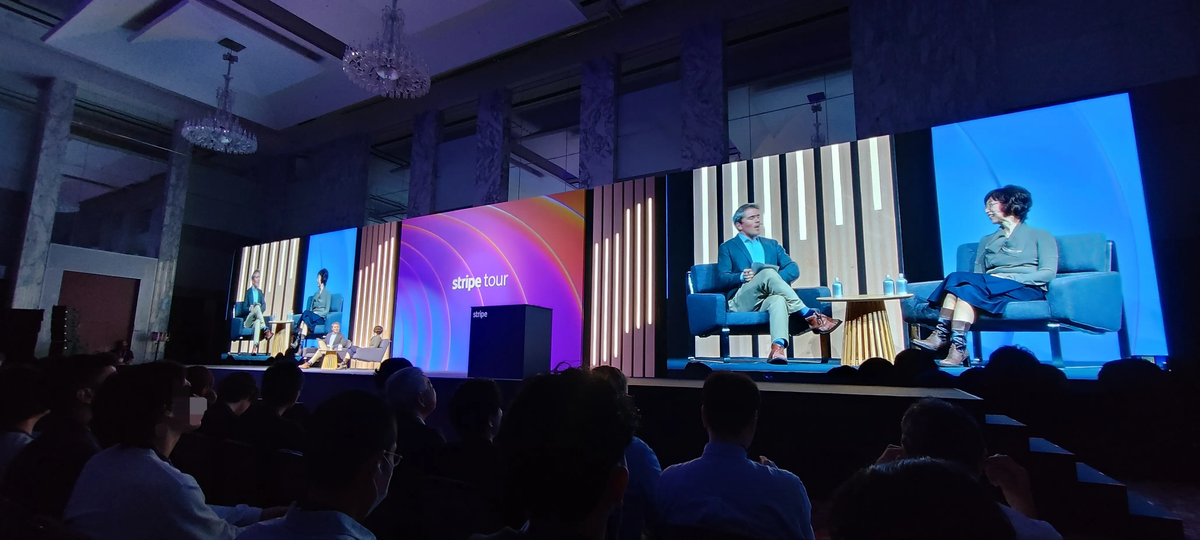
I attended Stripe Tour Tokyo 2026 on September 30. The morning was an invitation-only CxO lunch for startups. I covered that on kafkai.com. This article is about the afternoon session: a 45-minute fireside chat with DeNA president and CEO Tomoko Namba, interviewed by Stripe co-founder and president John Collison.
The topic was AI-era organisations, the Japanese economy, and leadership. It was relevant both for leaders rolling out AI and for people whose working lives are already changing because of it.
Why Namba Returned as CEO
Namba founded DeNA in 1999. When Collison asked why she came back to the CEO role, she said the full explanation would take the whole 45 minutes. The short version had three parts. She wants to bring momentum back to DeNA. She wants to make DeNA the most comfortable place for entrepreneurs to work. And she wants to channel that energy into building bigger businesses.
AI Was Rolled Out Company-Wide. People Did Not Move.
Namba had previously declared that DeNA was going "all-in on AI." The plan was to deploy AI across the whole company and move half the workforce into launching new businesses.
The result was half a success and half a failure. DeNA is a tech company, so there was no psychological resistance to AI. Everyone started using it. The same number of people got more work done.
But the movement from existing businesses to new ones never happened. The reason was simple. The time freed up by AI was filled with more existing work. The work was not unimportant. But it was additional work that the company had managed without before. In other words, productivity went up, but redeployment did not.
Namba drew a lesson from this. You have to move people first, or at least at the same time as you introduce AI. If you wait for the conditions to be perfect, they never will be. If you move people first, some work will get dropped. The organisation learns from that. DeNA is now actually moving people under this policy. She said they are still halfway there.
I think this applies to a lot of companies. Higher productivity from AI does not automatically lead to new initiatives. Freed-up time, left alone, gets absorbed by existing work.
Bring Change From Outside. Leave the Ability to Keep Changing Inside.
So how do you change the organisation? Namba introduced small "AI SWAT teams."
These teams embed in each business unit and work with the unit head to solve problems. They run intensive two-to-three-day sessions to identify the most important problems and build solutions together. The output is either a productivity gain or something the unit could not do before. Namba said showing visible results first was critical.
The legal department came up as an example. Legal staff initially assumed their work could not be replaced by AI. In practice, a large volume of their work was not that important. When AI took that on, the legal team could focus on complex, difficult cases. Collison responded that Stripe's legal team had been very proactive about AI too. Legal work is mostly public regulations and rules, all in text, so it suits AI well.
Customer success, quality assurance, and some operations were rebuilt from scratch on the assumption that AI would be used. The hard part is that AI technology changes every day. So the optimal shape of operations keeps changing too.
What Namba emphasised was this. Even if outside AI teams come in at first to change the structure, the people on the ground need to be left with the ability to keep changing it themselves. One line stuck with me: "Even a perfect solution today, if you freeze it, is outdated in a week." At DeNA now, not just customer support but anyone can build their own software to solve their own problems.
New Graduate Hiring: Actually Increasing
There is a common argument that AI takes away junior people's work. Basic tasks like taking meeting minutes are done by AI now, so there are fewer chances to train young people. Some research shows slightly lower youth employment in AI-exposed industries.
Namba's view was the opposite. DeNA is increasing new graduate hiring. Young people use AI better. They have more agency, better taste, and are more innovative. There is no need to make them take meeting minutes to train them. They become productive immediately.
What Japan Needs: Labour Mobility
Collison asked what Japan's economy and companies need to adapt well to AI.
Namba's first answer was labour mobility. AI is improving every day. The boundary between what AI is good at and what humans are still good at is moving every day. The economies that can keep up are the ones with high labour mobility. In the US, old companies exit, new startups emerge, and people move quickly. Even so, Namba estimates it takes about six months to catch up to the moving boundary.
Japan's labour mobility is extremely low. The market is "almost calcified." There are regulatory issues, and there are workplace customs that have persisted for decades. These are problems that have existed for decades, but they become more serious in the AI era.
Namba asked for another shift in thinking. Frontier AI models are being built only in the US (effectively the West Coast around San Francisco) and China. But that does not mean Japan has few business opportunities. Every industry and every part of individual life is going to change. The companies building models cannot capture all of that opportunity. The opportunity is at the customer front line, in applied AI. And periods of total change favour startups and challengers over established large companies.
This connects to what Professor Yutaka Matsuo discussed on NHK about how Japan should approach AI. You do not have to focus only on the model-development race.
DeNA's Core Business Is a "Business Factory"
DeNA's businesses span baseball, games, healthcare, and AI. Namba is often asked what the core business is. Her answer: a "business factory."
DeNA keeps building new businesses. It keeps half in-house and sells half. Namba described this as "like having Y Combinator inside the company." The difference is that Y Combinator does not own the businesses. DeNA chooses which ones to own.
The criteria for keeping a business or spinning it out are clear. Where would the "delight" the business creates be maximised: inside DeNA or outside? Specifically, if DeNA's assets and resources can grow it, the business stays.
To run the business factory well, you need to attract challengers and entrepreneurs. DeNA has set up several mechanisms for this.
- People who successfully launch new products inside the company get rewards close to what they would get outside. There are no VCs inside the company, so there is no equity return.
- For people who leave DeNA to start companies, DeNA becomes their first investor. Inside or outside does not matter. The connection is what counts.
- Investment commitments and criteria are made explicit upfront. What areas DeNA is watching now, what standards it invests by, and what standards trigger withdrawal. If a business is discontinued, the team can take it outside.
The focus area now is applied AI, both consumer and enterprise. In one to two years, the focus may shift to physical AI (robots and other AI that moves in the real world).
As businesses multiply, the CEO cannot understand everything. Even with AI's help, Namba said this frankly. So she thinks of DeNA as an "ecosystem." In Silicon Valley, there is no "mayor" who understands everything. But if the flow of people and information is maintained and the ecosystem functions in balance, the whole thing works. Keeping that flow going is the CEO's job.
Japanese Enterprise AI: Deployed, But Results Are Still Rare
Collison also asked about the current state of AI adoption in Japanese companies. According to Namba, there are practically no large enterprises left that are not using AI at all. Everyone is deploying it organisation-wide. But the number of companies where visible results have started to appear is still small.
Collison described the situation in the US. When you contact large-company customer service now, a chatbot comes up first. Previously you would have thought, "I want to speak to a human." Now you think, "I want to speak to the chatbot, not a human. It's smarter."
The gap between "deployment" and "results" is something we have seen before. McKinsey's survey showed that 78% of companies have adopted AI. Bringing in tools and changing how work is done are different things. Namba's story about AI being deployed but people not moving is a good explanation of where that gap comes from.
Making AI Your Chief of Staff
The most concrete and interesting part for me was how Namba personally uses AI.
She has connected AI agents to her communication tools, databases, calendars, everything. She has about 15 internal meetings a day on average. The AI agent prepares each one perfectly. For weekly meetings, it summarises what instructions she gave last time and what she promised to do. The agent also manages her todo list and follows up with her until items are done.
When Collison said, "So Claude is your chief of staff," Namba nodded. She also said she might be more efficient than 15 years ago, and that she could not do her current job without AI.
Returning as CEO means not just setting strategy but executing it. Execution involves a massive volume of interaction with people. AI is what supports that load.
From Decider to System Builder
Has leadership changed compared to 15 years ago, when she was last CEO? Namba said it has changed a lot.
Back then she was the decider. She thought her responsibility was to decide everything herself. Now she focuses on whether decisions are being made properly, whether information is being shared properly, and whether the right people have access to data. She thinks it is healthier to check that the system works than to make every decision herself.
Another change is in how she builds organisations. Before, she tried to build organisations optimised for the current environment. But now change is too fast. Even an organisation optimised for today's technology and society becomes useless three months later if you freeze it. So now she aims to give the organisation itself the ability to keep changing.
Here too, Namba used Silicon Valley as an example. Semiconductors, PCs, mobile, SaaS, Web3, and now AI. The leading companies keep changing. But the ecosystem as a whole stays vibrant. That is the kind of organisation she is trying to build. I heard the phrase "trying not to build anything calcified" several times during the session.
Collison on the Value of Staying With Hard Problems
Later in the session, Namba asked Collison how he and his brother Patrick (Stripe CEO) run the company together. Collison joked that Namba would be a good host for his podcast, Cheeky Pint.
Collison's answer was about the value of staying with something for a long time. NVIDIA has been making GPUs since the 1990s. They made them for computer graphics, developed technologies like CUDA, and then the AI wave arrived. They were not planning for the AI era. They kept building useful technology, and that let them catch the next wave. Sticking with important problems, not giving up, not getting bored, not turning away. That is what matters.
Their division of roles was interesting too. The common story is that complementary skills make a good founding pair: one business, one technical. But what balances Patrick and John Collison is personality. Patrick always wants to do new, bold things and spend all the company's money. John wants to make a profit and run a responsible business. The healthy tension between them produces the right answer.
What Silicon Valley Can Teach
Namba still visits Silicon Valley often. What impresses her every time is speed and ambition. Japanese startups are much faster than established companies, but there is still a gap compared to US startups.
And the overflow of knowledge. In Silicon Valley, everyone shares everything. Namba meets mostly the same people each visit, and gets the latest information there.
The contrast on ambition was striking too. In Japan, ambitious people are sometimes treated as odd, and it is harder to raise investment. In the US, if you show up with a conservative, safe business plan, nobody listens. People with bold ideas get respect.
Collison added something about this "overflow of knowledge." Silicon Valley is like one big boiling pot of knowledge. Companies try to keep knowledge inside, and they fail. Anthropic was founded by people who were at OpenAI. The people who founded OpenAI were working on AI at Google. The fact that companies cannot keep secrets is one reason Silicon Valley works.
On the Role of Government
The session ended with policy. Namba praised the Japanese government for being enthusiastic about supporting startups and investing in 17 priority areas. She said it is good that economic growth is being taken seriously.
But she questioned whether the government is good at deciding which fields to invest in, and whether that is even the government's role. Collison agreed that historically, governments are not particularly good at this.
After the Session
The word I think Namba used most often during the 45 minutes was "calcified." Calcified operations, calcified organisations, calcified labour markets. In the AI era, calcified things become outdated fast.
The other takeaway was the lesson that deploying AI does not mean people will naturally move. Freed-up time, left alone, gets absorbed by existing work. If you want to start something new, move people first. I think this applies to large companies and to small ones like ours.
I read Namba's book from 2013, "不格好経営: チームDeNAの挑戦" ("Clumsy Management: Team DeNA's Challenge"), some time ago. It left an impression and is one of my favourites. It was good to hear her speak directly this time.
My thanks to Namba, Collison, and the Stripe Japan team for organising the session.