
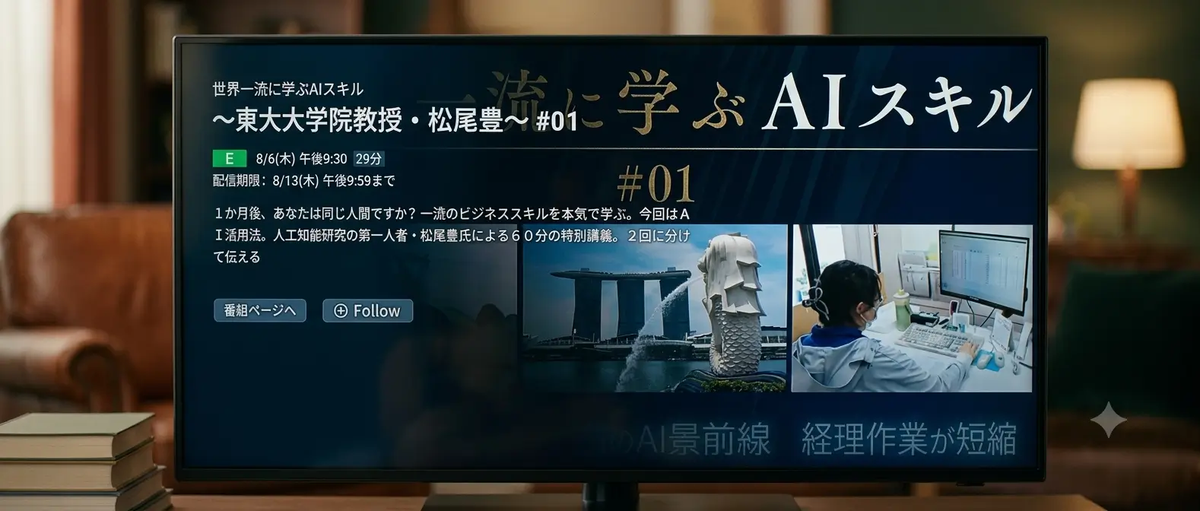
On 6 August 2026, Prof. Yutaka Matsuo of the University of Tokyo Graduate School, who also chairs the government's AI Strategy Council, gave a 60-minute NHK special lecture titled "AI Skills Businesspeople Should Learn." It was aimed at working professionals who have heard about AI but are not sure how to apply it in practice. I happened to catch it, thought the content was good, and decided to share it here.
Prof. Matsuo's core message was that AI will not take your job. People who do not use AI will.
What Country-Level AI Rankings Show About Japan's Position
At the start of the lecture, Prof. Matsuo presented country-level AI rankings from 2024. The United States was first, China second, and the United Kingdom third. Singapore, a country of under six million people, ranked seventh. Japan was eleventh.
The United States and China are the dominant forces in the AI frontier. OpenAI, Anthropic, and Google are the three companies that define it. OpenAI is valued at roughly $852 billion. Anthropic, still private, is valued at around $965 billion. These numbers go well beyond normal technology valuations. They show how convinced global investors are that AI will rewrite the foundations of society.
Prof. Matsuo recently attended ATxSummit 2026, an event hosted by the Singaporean government that brought together ministers, senior officials, and global researchers. The Punggol Digital District project is currently under way there. Self-driving vehicles on the roads, robots woven into daily life — the goal is a city where AI is infrastructure itself. "The national will to do this all at once was overwhelming," Prof. Matsuo recalled.
AI adoption is no longer a decision for individual companies. It is a national competitiveness issue. Prof. Matsuo presented an estimate: if AI were adopted across Japan, real GDP growth could be lifted by 0.5 to 1.6 percentage points per year. For an economy that has hovered around 1 percent annual growth, this is the difference between stagnation and renewal.
What the Live Demo Showed About AI's Practical Use
A large portion of the lecture consisted of live demonstrations.
Prof. Matsuo first showed how he uses ChatGPT as a conversational partner. He switched languages mid-conversation — English, French, Spanish, Mandarin — and finally asked it to speak in Osaka dialect. This was not a novelty act. It demonstrated that the barrier to multilingual communication has effectively fallen.
Next, he asked the AI to build a shooting game. The request was deliberately vague: "Make something like a shooting game." A human programmer would have asked for clarification. The AI generated code immediately, and when Prof. Matsuo pressed run, it worked. When he asked it to make the design cuter, the code was rewritten on the spot. Work that would have taken days was done in minutes.
At this point, Prof. Matsuo brought up the current situation in the United States, where AI researchers themselves are finding their jobs threatened by the tools they built. His response was not to give in to fear, but to make AI an ally.
The AX Framework: A Five-Stage Roadmap for AI Adoption
Prof. Matsuo presented a five-stage model called AX — AI Transformation — as a roadmap for how companies should approach AI.
AX Stage 1: Introduce generative AI. Make tools like ChatGPT available within the company. Email drafting, translation, meeting summaries, simple research. Prof. Matsuo stressed that even this stage produces significant productivity gains. The programme featured a small company in Ibaraki where an employee had been spending an hour every morning manually entering data from delivery slips and invoices into a spreadsheet. With a generative AI tool, they simply uploaded two files, added a prompt, and finished in one minute. No special software. No external consultants.
AX Stage 2: Connect company data. Once employees are comfortable, let AI access internal documents, customer records, and confidential information. An AI that understands your company's context becomes far more useful for sales materials and accounting work. Prof. Matsuo cited the spread of cloud computing as an analogy. Companies that once feared storing data externally now live in an era where government agencies and banks use cloud services as a matter of course. AI is following the same path.
AX Stage 3: Redesign workflows. This is not about speeding up existing tasks with AI. It is about rethinking processes with AI as the starting assumption.
AX Stage 4: Develop proprietary AI. Build specialised models that leverage your company's unique strengths and data assets.
AX Stage 5: Build industry-wide AI platforms. Create foundation models that extend beyond a single company to serve an entire sector.
Prof. Matsuo repeatedly emphasised that companies should start with Stage 1 and 2 immediately. These do not require large investments. If the motivation and willingness to try are there, you can start today.
Prompts Are Just Clear Instructions
The programme also covered "prompts" — the instructions you give to AI. Prof. Matsuo made a key clarification: this is not a specialised IT skill. It is the same skill as managing people.
When you delegate to a human employee, the more specific you are, the better the result. AI works the same way. Prof. Matsuo used an email revision example. Instead of saying "fix this email," he wrote: "Review this apology email to a client. List your changes with reasons. Do not stop at fixing typos — suggest more polite phrasing where appropriate." With clear boundaries, the AI produced exactly what was needed.
Vague instructions produce vague results. This is not a limitation of AI. It is a communication principle that has not changed in human society.
What AI Gets Wrong
Prof. Matsuo did not present AI as infallible. He named two weaknesses that every business user should know.
Hallucinations. AI can lie with confidence. It sounds plausible, but the content is fabricated. This is a known characteristic of large language models, not a rare glitch. I wrote about this before: AI hallucinations are real, predictable, and manageable if you know what to look for. Prof. Matsuo's advice was simple: always verify facts, figures, and proper names by hand.
Counting. AI is surprisingly bad at precise enumeration. Counting apples in an image, or occurrences of a specific letter in a word — these tasks often fail. This is not a temporary bug. It is a structural limitation rooted in model architecture. Prof. Matsuo said the key is to calmly learn what AI does well and what it does not, then assign tasks accordingly.
Corporate Data Safety — How to Approach It
A concern that came up repeatedly in the programme was whether company data is safe when uploaded to AI services. Prof. Matsuo addressed this directly. Commercial AI providers handle corporate data with the same care that cloud providers apply to government and banking information.
For those who remain concerned, two practical steps were offered. First, disable the "use data for training" option in the settings. Second, draw a clear internal line: this is OK, this is not. Prof. Matsuo noted that Japanese companies tend to be overly cautious and fall into blanket bans. When the decision criteria are explicit, employees actually become more confident, not less.
Why Now
Prof. Matsuo closed with words that should resonate with anyone watching Japan's economic position.
Japan still has enormous untapped potential. Large parts of the economy remain undigitised. This is not backwardness. It is an opportunity. Countries that have already completed digitisation must retrofit AI into existing systems. Many industries in Japan can move directly to AI-native workflows.
The inefficiencies that have dragged down productivity for decades — manual data entry, paper-based approvals, fragmented customer management — can be resolved in months, not years, if companies commit to the first two stages of the AX framework.
I have written before about Japan's potential to lead in AI globally and about the competitive imperative for Japanese companies to adopt AI. Prof. Matsuo's lecture is the clearest explanation I have seen of why those arguments matter at the individual desk level. He is not asking businesses to become AI companies. He is asking them to become companies that use AI.
The programme is available on NHK's streaming service until 13 August 2026 at 9:59pm. If you run a business in Japan, or work in one, it is worth the hour.