
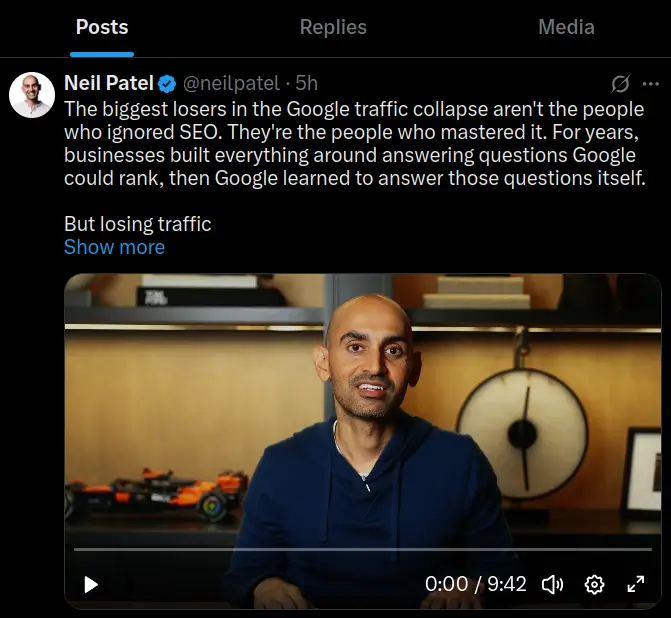
A few days ago Neil Patel published a short video on X that has been doing the rounds among marketing circles. In it he makes a familiar argument with new numbers: Google organic traffic is collapsing, AI overviews are swallowing clicks whole, and the businesses that built their entire audience on rented land are waking up to find the landlord changed the locks.
If you do not know Neil, he is one of the most visible voices in digital marketing. He co-founded NP Digital, an agency that works with brands large enough to have their own SEO teams. He has been publishing on search, content, and conversion for well over a decade, and he tends to lead with data rather than hand-waving. That is worth knowing because it means when he says the ground has moved, it is not panic bait. It is a measurement.
The Diagnosis Is Brutal and Accurate
Neil's core claim is simple. The biggest losers in the Google traffic collapse are not the people who ignored SEO. They are the people who mastered it.
For years publishers, blogs, directories, and media companies built their entire businesses around answering questions Google could rank. Then Google learned to answer those questions itself. The scary part is not just that traffic is down. It is that many businesses never owned the audience in the first place. They rented it from Google.
He pulls some sobering figures. At NP Digital their own data shows organic traffic growing almost 6% in 2023, dropping to minus 7% the year AI overviews launched, then down more than 13% the year after. By early 2026, 68% of Google searches ended without a single click to the open web. AI overviews now appear on close to half of all searches, and when one shows up click-through rates drop by roughly 60%.
This is not a ranking problem. It is a landlord problem. I have written about this before in the context of AI search and brand authority: if your entire discovery strategy depends on a platform you do not control, you are not running a business. You are sharecropping. (Authority, Citations, and Branding in the Age of AI)
The HubSpot Exception That Proves the Rule
Neil points to HubSpot, which reportedly lost about 80% of its organic traffic in a single year. By old metrics that is a catastrophe. Yet over the same stretch their revenue grew more than 20%.
The reason is brand demand. People do not search "best CRM software" to find HubSpot. They search "HubSpot." The clicks left. The demand stayed. As Neil puts it, clicks and demand are not the same thing, and the industry spent fifteen years measuring the one that is now disappearing.
This is exactly what I have argued about trust and conversion. Traffic is nice, but trust is what converts. A visitor who types your name into a search box has already decided. The search engine is just the directory. (Traffic Is Nice, but Trust Is What Converts)
The pattern holds across the board. The average website gets 2.4% of its search traffic from its own brand name. Top performers get nearly 10%. The winners are not ranking better for generic terms. People are searching for their name.
Where Neil and I Part Ways
Neil's prescription is what he calls "search everywhere optimization." Build demand for your name in every place people look. Google, YouTube, TikTok, Instagram, Reddit, ChatGPT, Gemini, Perplexity, newsletters, podcasts. He points to Meredith Corp, which grew off-platform audience on Instagram, TikTok, YouTube, and Apple News by more than 60%, signed licensing deals with OpenAI and Meta, and built their own app so people come straight to them.
Here is where I have to disagree, at least for the audience I write for.
The Fake Meredith Big Corp is a multi-billion-dollar publisher with teams, budgets, and legal departments that can negotiate licensing deals with OpenAI. Most small businesses I know do not have a social media manager, let alone an AI licensing team. Telling them to "be everywhere" is not strategy. It is exhaustion dressed up as ambition.
I have given talks about this exact tension to small business owners in Melaka and elsewhere. The internet is land, and you should own a piece of it instead of renting forever. But that does not mean buying up every plot in every country. It means buying one plot and building a house on it. (Your Domain Is Your Brand)
Your website is the only place where you have 100% control. Not algorithm control. Not terms-of-service control. Real control. You set the rules. You own the customer list. You keep the data. Nobody can shadow-ban you, throttle your reach, or change the layout overnight and bury your contact form.
The Practical Middle Ground
This does not mean ignore every other platform. It means treat them correctly.
Social media, AI search, and third-party directories are rented stalls in busy malls. The footfall is real. Use them to be found. But understand exactly what they are. When you build your whole business on an Instagram page, you are renting a stall in a mall that belongs to someone in California. The landlord sets the rent, and in social media the rent is called reach.
The real goal is not to be on a dozen platforms at once. The real goal is to be the brand people already look for when they show up at whichever platform they happen to be using. And more importantly, to make sure every one of those rented stalls has a clear path back to the property you actually own.
Your website. Your domain. Your email list.
That last one matters more than most people admit. An email address is the closest thing to an owned relationship you can have online. Followers are borrowed. A customer list is owned. No algorithm sits between you and them.
So the playbook for a small business is narrower than Neil's, but it is executable:
- Own your domain. Make it the centre of gravity for everything you publish.
- Publish something worth remembering. Not generic answers that AI can summarize away. Your perspective, your experience, your failures, your specific point of view.
- Use other platforms as signposts, not destinations. Post there, engage there, but always find a way to walk visitors home.
- Capture the relationship. Every CTA should aim for an email subscription, not just a follow or a like.
The Brand Is the Part You Keep
Neil ends his video with a line I fully endorse: "The traffic was always temporary. The brand is the part you actually keep."
Where we differ is the method. For a company with NP Digital's resources, search everywhere optimization is a viable strategy. For a freelancer, a local restaurant, a boutique consultancy, or a solo founder, it is a recipe for burnout and mediocrity across ten channels.
The smaller you are, the more important it is to concentrate your firepower on the one channel you actually own. Build a brand people remember. Make your website the destination. And treat every other platform as what it is: a rented stall that can close without warning.
That is not giving up on SEO. That is finally doing it right.