
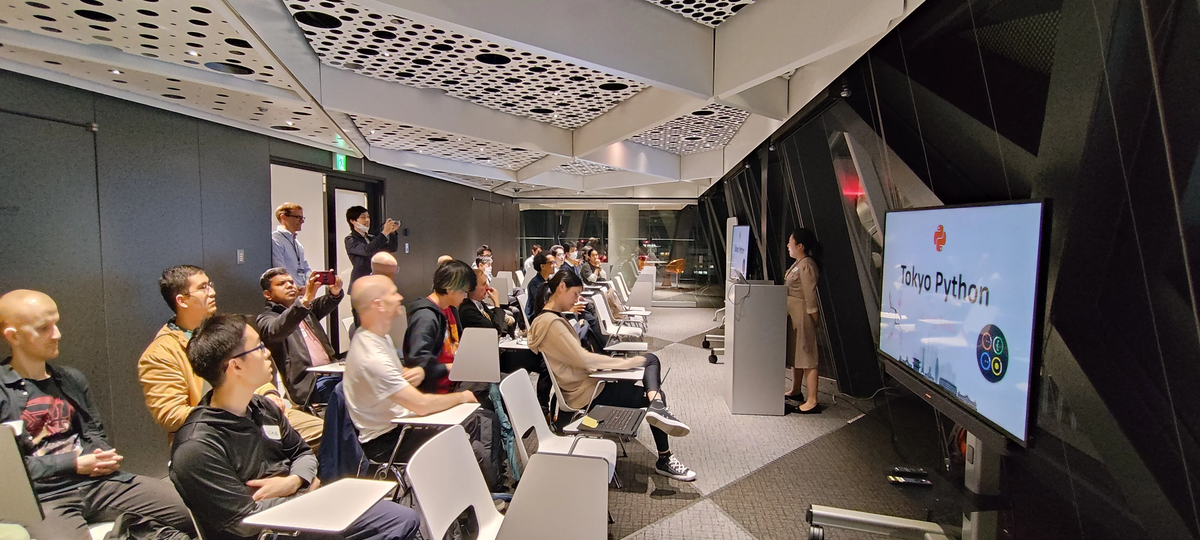
On the 15th of April I spoke at the Tokyo Python Spring Talks meetup, hosted at GDG on Campus at the International Professional University of Technology (IPUT) in Tokyo. It was a good evening — two technical talks, solid conversations during the networking session, and a few unexpected connections.
Tokyo Python has been around since 2017, founded by William Touzalin. It's one of those meetups that genuinely welcomes people at all levels, and last night was no exception. We had a mix of seasoned developers, students, and a few first-timers.
The Talks
Ankhbold Batbaatar — About GDG on Campus IPUT
Ankhbold opened the evening with a quick introduction to GDG on Campus — a student-led Google Developer Groups chapter at IPUT. He talked about the global GDG network (those blue dots on the map are everywhere), DevFest Tokyo which drew over a thousand registrants, and how students can tap into Google Developer Experts for talks and hackathons. It was a nice reminder that university communities are doing meaningful work in this space.
Iqbal Abdullah — Ever Wondered What Happens When You Click Send
That was me. I opened with my usual Python Anonymous bit — hi, my name is Iqbal, and I use Python — which got the laugh it deserved. I talked about email in the Python ecosystem — a topic close to my heart because two months ago we launched KaiMail, our email forwarding and sending service for custom domains. The motivation is simple: developers hoard domain names (guilty as charged), and open source communities deserve to use their own domains for email without paying big corporations for the privilege.
I walked through the history of email (it predates the web by 20 years), the core protocols (SMTP, IMAP, POP3), and the authentication mechanisms that make modern email work — SPF, DKIM, DMARC, and ARC. Then I got into the Python side: parsing emails with email and smtplib, signing with dkimpy, checking SPF records with pyspf, and handling ARC chains (which tripped me up the first time because you need to reverse the header order). I had 31 slides for 20 minutes, so I rushed through quite a bit — but the key takeaway is that Python's standard library has surprisingly comprehensive email support, and the third-party ecosystem fills in the gaps for authentication and signing.
I also mentioned PyCon Asia briefly and showed some photos from the recent conference in Manila. If you're in this part of the world and haven't been to a PyCon Asia conference, I'd encourage you to check it out — it's the largest international Python conference on this side of the planet, and you don't need to fly to Europe or the US to attend one. We've written about our experience at PyCon APAC 2025 in Manila on the Kafkai blog if you're curious.
I've posted the slides of my talk and a post on the talk itself on kaimail.net's blog here if you're interested to know more.
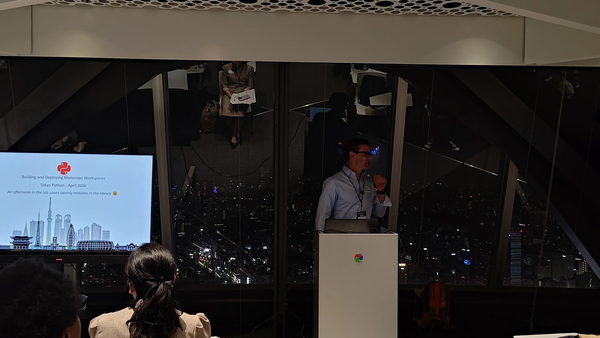
Ben Allen — Developing and Deploying Monorepos Using uv Workspaces
Ben gave a practical talk on using uv workspaces to manage Python monorepos. Before uv came along, there wasn't really a standardized way to handle Python-based monorepos — teams cobbled together their own solutions, and none were perfect.
He walked through a case study — an S&P ETF lag detection system with three microservices (extractor, processor, uploader) and a shared library — showing how the pyproject.toml workspace configuration ties everything together with a single lock file and a single virtual environment. The Docker deployment strategy was particularly useful: a multi-stage build using --frozen and --no-install-workspace flags to separate dependency installation from source code, keeping builds fast. He also shared a neat security tip: you can prevent uv from loading any PyPI package published less than three days ago to protect against supply chain attacks.
Ben mentioned something I found relatable — he uses bash for deployment scripts now because LLMs write pretty good bash. As he put it: it's a bit like what's happening with ORMs and raw SQL. You don't need to write it anymore; you're the manager now.
The Conversations
The networking session is always where the real value of meetups comes through.
I ended up having a longer conversation with Colin from CodeHQ, who's paying Google 10 euros a month just to receive email at his custom domain. He's not happy about it, and neither am I — this is exactly the problem KaiMail is designed to solve. We talked about how open source communities shouldn't have to pay big corporations who don't need their money. Digital subscription creep is real: 10 euros here, 10 euros there, and before you know it you're spending 100 dollars a month.
I met Kenji, a Brazilian developer attending his first Python meetup ever. He previously worked in a factory in Japan before transitioning to a post-tech developer role. It's interesting and always a wonderful thing to listen to stories of people who switched careers from totally different backgrounds and Python seems to have had helped in someway along the way.
There was also a fun moment when I discovered that Tinish and Bucky — who were also at the meetup — were Malaysian. We switched to Malay mid-conversation. Tinish is from Batu Caves, while Bucky is from Puchong, both neighborhoods I'm familiar with. Tinish is part of the Malaysian Student Association in Japan and was surprised to meet a working Malaysian in the wild. I encouraged him to get more involved in the broader tech community — there are more of us here than people think.
I also briefly connected with Calvin who is visiting from Hong Kong but a regular at our regional conference circuit, and we discussed the possibility of a future collaboration. More to come on that.
Another PyCon circuit regular Yuichiro Tachibana was also there. He was wearing the PythonAsia 2026 in Manila t-shirt. We exchanged a few words and talked about the upcoming PyCons this year.
Another interesting encounter was an Armenian startup founder who's in Tokyo until May 1st showing their product to Python developers. e shared an interesting story about migrating a media upload microservice from Node.js to Python — it went from 8 seconds to 2 seconds. I told him that's a lightning talk right there, and we went to talk to Ben about getting him a slot at the next meetup. They'll be at SusHi Tech Tokyo 2026 too — where Kafkai is exhibiting as an official ambassador from April 27-29.
Why People Stay
One conversation that stuck with me was about why people stay with Python. I told someone at the meetup — and I genuinely believe this — that I stayed with Python not because of the language. It's because of the people. Ben, Kelvin, the folks I've met through PyCon JP, PyCon MY, and communities across Asia. Python's community is what keeps people coming back.
That's what a meetup like Tokyo Python is about. It's not just the technical content — it's the connections you make and the conversations you have afterwards.
If you're interested in more of our community involvement, you can read about our PSF Community Service Award or our experiences at DjangoCon Africa and the Dhaka Python meetup.
Thank You To The Organizers
Something we tend to take for granted is the hard work put in by the organizers of these meetups, and they also play the most pivotal role on why people stay. Working to find venues and sponsors continuously to give space for people to meet and share stuff is the reason people can stay in the first place.
A huge thank you to Ben Allen and Ai Matsushita for always working hard being our community organizers, hosts and MC!
Next Meetup
Tokyo Python's next event is Lightning Talks on Wednesday, May 20th, 7-9 PM at Le Wagon in Meguro. If you're in Tokyo, come say hello. And if you've never given a talk before, a lightning talk is the perfect way to start. Five minutes. That's it.
You can find Tokyo Python on Meetup.com, their website, or Discord.