

Last updated: September 17, 2026. This article merges and replaces our earlier guides "Network vs. Affiliate Marketing: Key Differences and Tools for Smarter Content Marketing" (January 2025) and "Differences Between Affiliate Marketing vs Network Marketing" (September 2023).
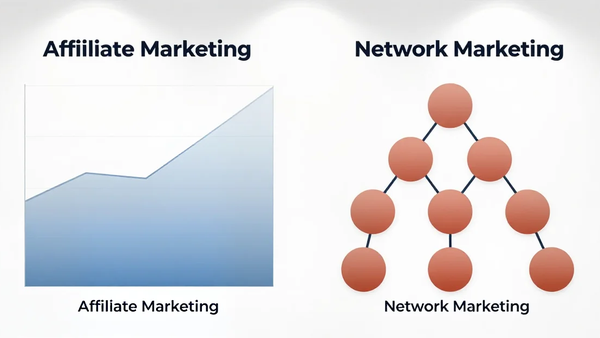
Affiliate marketing and network marketing pay you a commission. That is where the similarity ends.
One pays you for sales you generate. The other pays you for the team you build and the sales that team generates. That single difference changes everything: how you spend your day, how much you risk, how fast you earn, and how well you sleep at night.
People mix the two up constantly. Search results are full of articles that describe one and quietly assume the other. This guide compares them directly, using the same criteria for each, so you can pick the model that fits how you actually want to work in 2026.
The Short Answer
Affiliate marketing pays you a commission when someone buys through your link. You own no inventory, recruit nobody, and can promote whatever you want. Cost to start: close to zero.
Network marketing (also called MLM, or multi-level marketing) pays you for your own sales and for the sales made by people you recruit into your team. Cost to start: often a starter kit or inventory purchase.
If you want to build a personal brand and control your own time, affiliate marketing is the simpler fit. If you want to build and lead a team and you are willing to recruit, network marketing offers a different kind of leverage.
The 5 Key Differences
1. Business Structure: Independent vs Hierarchical
Affiliate marketing is flat. You sign up with a merchant's affiliate program, get a tracking link, and promote it. There are no uplines, no downlines, and nobody above you setting quotas. You can hold affiliate relationships with ten different companies at once.
Network marketing is hierarchical. You join as a distributor, and you recruit others beneath you. When your recruits sell, you earn a share. When they recruit, your network deepens and your commission share extends further down. Your income depends partly on a structure you have to keep building.
Why it matters: In affiliate marketing, your effort maps directly to your result. In network marketing, your result depends on other people's effort too — which is either the opportunity or the problem, depending on your temperament.
2. Income Model: Sales vs Team Sales
Affiliate marketing pays on transactions. A customer clicks your link, buys the product, and you earn a percentage. When you stop promoting, the income stops, unless you have built an audience that keeps arriving on its own.
Network marketing pays on two channels: your personal sales, and a commission on team sales across several levels. The promise is compounding — a team that keeps selling while you sleep. In practice, the compounding only materialises for the small share of distributors who build a large, active team and keep it active.
Why it matters: Affiliate income is linear and predictable. Network marketing income is non-linear and uneven. Neither is better. They fail in different ways.
3. Recruitment: Optional vs Essential
Affiliate marketing has no recruitment requirement, ever. Nobody asks you to bring in five new affiliates to keep your commission rate. You grow by publishing better content, ranking higher, and converting more traffic.
Network marketing treats recruitment as the engine. Most compensation plans reward you more for a new distributor than for a new customer. Meetings, calls, and training are all pointed at expanding the network.
Why it matters: If you dislike selling the opportunity, network marketing will grind you down. If you enjoy recruiting and mentoring, affiliate marketing will feel slow and lonely.
4. Cost: Near Zero vs Starter Kit
Affiliate marketing costs almost nothing to start. You need a domain, hosting, and maybe a tool subscription. There is no starter kit, no inventory, and no monthly order requirement. Your main investment is time and content.
Network marketing usually charges an entry fee. That may be a starter kit, a minimum product order, or both. Some plans also require a monthly purchase to stay "active" and eligible for commissions.
Why it matters: Affiliate marketing caps your downside. Network marketing asks you to put money in before you know whether you can sell. Check the terms before you pay anything, and be careful with any plan whose main revenue comes from recruiting rather than from selling to real customers.
5. Risk Profile: Market Risk vs Structural Risk
Affiliate marketing carries market risk. You can lose your rankings to an algorithm update. A merchant can cut your commission rate or close the program. A competitor can outspend you on the same keyword. Your risk is exposed but visible.
Network marketing carries structural risk on top of market risk. Regulators scrutinise MLM compensation closely. A plan that rewards recruitment more than product sales can be classified as an illegal pyramid scheme, depending on the jurisdiction. In Japan, the Act on Specified Commercial Transactions and the Act against Unjustifiable Premiums and Misleading Representations both apply, and the 連鎖販売取引 (or "chain sales transaction") rules impose cooling-off rights and disclosure duties on distributors.
Why it matters: Affiliate marketing can hurt your income. Network marketing can hurt your income and expose you to legal and reputational problems if the company you join operates badly. Choose the company with more care than you choose the product.
Side-by-Side Comparison
| Criterion | Network Marketing | Affiliate Marketing |
|---|---|---|
| Business structure | Hierarchical, with recruitment and downlines | Flat, independent affiliates |
| Income source | Personal sales plus team sales across levels | Commission on sales or leads you generate |
| Recruitment | Core activity, strongly incentivised | None required |
| Upfront cost | Starter kit or inventory, often required | Near zero; domain, hosting, tools |
| Monthly obligation | Sometimes a minimum order to stay active | None |
| Income shape | Non-linear, depends on team activity | Linear, depends on your traffic |
| Speed to first income | Months, while the team forms | Weeks, from first converting content |
| Ceiling | Very high, if the team scales | High, limited by traffic and niche |
| Main risk | Structural and regulatory | Algorithm, merchant, and competition |
| Best for | People who like recruiting and leading | People who like publishing and optimising |
| Control over product | Low; you sell one company's line | Low; but you can switch programs freely |
| Exit cost | Team collapses when you stop | Content keeps earning while it ranks |
Which Model Fits You?
Five questions. Answer honestly.
Do you enjoy recruiting people?
- Yes → network marketing becomes viable.
- No → affiliate marketing.
Can you absorb a monthly product order?
- Yes → network marketing is not ruled out.
- No → affiliate marketing.
How fast do you need income?
- Within weeks → affiliate marketing.
- Over a year → either model, but network marketing needs the runway.
Do you want to promote many products or one line?
- Many → affiliate marketing.
- One company's line, deeply → network marketing.
How do you feel about your income depending on other people's effort?
- Energised → network marketing.
- Uneasy → affiliate marketing.
Most of the content creators we work with land on affiliate marketing. Not because MLM is invalid, but because their skill is publishing and distribution, not team recruitment. The affiliate model pays directly for the skill they already have.
The Tools That Actually Help
This is where the two models overlap most. Whether you promote one company's line or twenty affiliate offers, the constraint is the same: you need content that ranks, converts, and can be produced at volume.
Content production
- Content ideation tools surface topics within your niche that have real demand. Kafkai generates article drafts from a keyword or a brief, which shortens the gap between idea and published post.
- Drafting assistants help you structure a first version. Treat the output as a skeleton you rewrite, not a finished article.
Search visibility
- SEO optimisation tools check titles, headings, internal links, and keyword coverage before you publish.
- Snippet formatting matters more than ever. Answer the query in your first 40 to 60 words, use tables for comparisons, and use numbered lists for steps. We covered why this matters in our article on why users never scroll past page one.
Promotion and distribution
- Email marketing tools segment your list and report open and click rates. For affiliate offers, an email list is usually the highest-converting channel you own.
- Social scheduling tools keep a steady posting rhythm across platforms without daily manual work.
- Multilingual tools let you publish the same article in Japanese and English. For anyone selling into Japan, this roughly doubles the addressable search demand.
- AI chatbots handle first-line questions and collect contact details while you sleep.
Measurement
- Analytics tools tell you which article produced which commission. Without attribution, you will keep writing content that gets traffic and earns nothing.
- Cohort tracking shows whether a piece keeps converting in month six or dies in month two. That difference decides what you write next.
One caution on the tools table from our earlier guide: buying a tool is not a strategy. We see many affiliates with a paid stack and no publishing habit. The tool removes friction; it does not supply the work.
Frequently Asked Questions
Can I do affiliate marketing and network marketing at the same time? Yes. Plenty of distributors run an affiliate blog alongside their MLM business. The risk is attention, not legality. Both models reward consistency, and splitting your week between them usually slows both. If you do run both, keep the audiences separate and set a fixed weekly time budget for each.
Which model offers a faster return on investment? Affiliate marketing, almost always. Your first commission can arrive within weeks of publishing content that converts. Network marketing income typically takes months, because it depends on recruiting and training a team before team commissions appear.
Is affiliate marketing the same as network marketing? No. This is the single most common confusion, and the source of most bad advice online. Affiliate marketing pays you only for the sales you generate. Network marketing pays you for your sales and for the sales of people you recruit. If a program requires you to recruit to earn, it is network marketing, even when the marketing copy avoids the term.
Are both models legitimate business models? Yes, when they are run properly. Affiliate marketing is a standard performance-marketing channel used by large and small companies alike. Network marketing is legal in most countries, including Japan, but it is regulated. The test is where the money comes from: a legitimate plan sells real products to real customers who are not also distributors. A plan that mainly pays for recruiting is a pyramid scheme and is illegal.
Are there legal considerations I should check? Yes. In Japan, chain sales transactions fall under the 連鎖販売取引 rules, which give buyers a cooling-off period and require the company to disclose the terms in writing. In the United States, the FTC and the states regulate MLM plans, and the FTC has taken action against plans that misrepresent income. For affiliate marketing, you must disclose affiliate relationships. The FTC requires a clear disclosure, and Japan's stealth marketing rules introduced in 2023 require similar transparency. Disclose on every page, in plain language, near the link.
Do I need technical skills to start? No, but the skills help. Affiliate marketing rewards basic SEO and writing ability far more than coding. Network marketing rewards sales and coaching ability. Neither requires you to build software. For affiliate marketing, being comfortable with a content management system, an analytics dashboard, and an email tool is enough to start.
How long does it take to earn income in each model? Affiliate marketing: the first commission usually arrives within one to three months of consistent publishing, though meaningful income takes six to twelve months. Network marketing: expect three to six months before team commissions become predictable, and note that most distributors never reach a meaningful income level. Treat any claim of fast, guaranteed income in either model as a warning sign.
What are the typical commission structures? Affiliate marketing pays a fixed percentage of each sale, commonly 5% to 30% depending on the product, or a flat fee per lead. The rate is transparent and stated in the program terms. Network marketing pays on a more complex plan: a percentage of your personal sales, a smaller percentage of your recruits' sales, and often bonuses tied to team volume or rank advancement. Read the compensation plan before joining and model the numbers with your own realistic sales estimate, not the plan's example.
Can I switch from one model to the other later? Yes, and the skills transfer better than most people expect. Content and SEO skills built as an affiliate are directly useful when promoting an MLM line. Recruiting and coaching skills built in network marketing are useful if you later hire a content team. What does not transfer is the audience, if you built it around a specific company's products.
How can tools improve my content marketing in either model? Tools remove the friction between an idea and a published, optimised article. Ideation tools find topics with demand. Drafting tools get you a first version. SEO tools catch structural problems before you publish. Analytics tools tell you which pieces earn. In both models the bottleneck is the same: producing enough content, in enough formats, to reach the audience that will buy. Tools raise your output; they do not replace the judgement about what to publish.
Is it worth starting in 2026, given AI Overviews and zero-click search? Yes, with a caveat. Simple informational queries now get answered inside Google, so "what is X" articles earn little. Affiliate content that still works targets commercial and comparison intent: real testing, specific recommendations, and original data that an AI summary cannot synthesise. We wrote about this shift in our zero-click research. The same applies to network marketing: generic recruiting content no longer moves anyone.
The Bottom Line
Affiliate marketing and network marketing are not competitors. They are two different bets on how you want to earn.
Affiliate marketing bets on your content. You publish, you rank, you convert, you get paid. The ceiling is your traffic, and the floor is zero cost to start.
Network marketing bets on your team. You recruit, you train, you keep the network active, you earn on the group's output. The ceiling is high, and so is the share of people who never reach it.
Pick based on the work you are willing to do every week for two years. If that work is writing, publishing, and testing, run affiliate marketing. If that work is recruiting, coaching, and running meetings, network marketing is worth a serious look — with a careful reading of the compensation plan and the local regulations first.
Either way, the content work is not optional. Both models need an audience, and the audience comes from publishing. Start there, and the model choice becomes much easier to make.