Published in AI & Technology
Translating Andrej Karpathy Keynote: Vibe Coding Transforms Small Business Operations

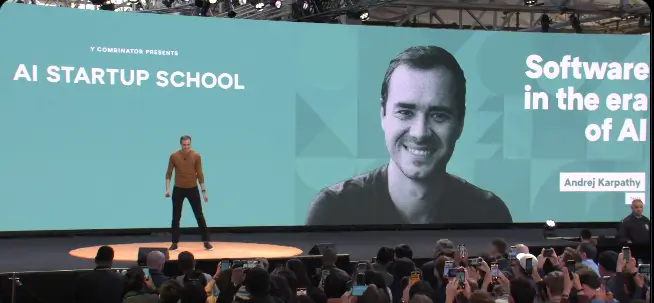
Watching Andrej Karpathy Keynote at the Y Combinator AI Startup School
One of the people that I follow and learn from when it comes to AI and Large Language Models (LLM) is Andrej Karpathy. Andrej is a Slovak-Canadian AI researcher who has worked in Stanford, and was Tesla's Director of Intelligence and also worked for OpenAI.
Andrej recently gave a keynote at a Y Combinator AI Startup School event and that got me thinking: Let's say you're running a small wholesale shop in Osaka, maybe 15 people total. Your competitor just launched an AI chatbot, your team is buried in manual data entry, and you're hearing that "AI is the new electricity." But here's the thing: you've got ¥50,000 a month to spend, not the millions Dentsu throws around. That gap between the hype and your reality? It feels impossible to bridge.
So I sat down to write this article thinking of tying the loose ends between what researcher like Andrej who works on the frontiers of the technology with how people like us can connect and utilize with it.
Back to Andrej's talk: He actually points to a different way forward. Forget building some superintelligent AI. For small businesses like yours, the real breakthrough is what he calls "vibe coding" your internal tools. Think of it as strapping an Iron Man suit onto your existing team. You most probably have heard the term "vibe coding" before, but let me explain what this actually means.
Your English (or maybe Japanese) is Your Best Programming Language
Andrej says we're in the "1960s era" of large language models: Expensive, centralized, but accessible through plain English. This completely flips the script for small businesses. You don't need a computer science degree; you need clear process docs.
Here's the simple version of his three software eras, matched to small businesses:
- Software 1.0: Your Excel macros, those inventory scripts you've been using forever, your legacy systems
- Software 2.0: The neural networks your supplier uses for demand forecasting (you don't build these, you just use the results)
- Software 3.0: You programming in English. Literally typing: "Create a Python script that checks our inventory CSV and emails me when items hit reorder point"
This isn't theory. Andrej built an iOS app in Swift without knowing Swift. A Tokyo import/export firm can build a customs document parser in two hours the same way. Their "programmer"? A 52-year-old operations manager who'd never written a line of code in his life.
What It Actually Costs
Let's talk real numbers. A Cursor IDE license runs about $20 per user monthly, around ¥3,000. The OpenAI API? Between $5 and $50 for typical small business tasks. Your team member needs about 3-5 hours to learn the basics. For a three-person team, you're looking at under ¥10,000 total for the first month.
You should try this if you've got repetitive digital work like data entry, report generation, email sorting, and at least one person who can write clear instructions in Japanese or English.
Don't bother if your processes are still a mess. LLMs can't fix what you haven't defined. This actually the hardest part especially if your processes includes multiple people from different parts of your company.
The Autonomy Slider: Stay in Control
Andrej has this line: "I'm always scared to get way too big diffs." For you, that means never let AI make 1,000 changes you can't check. Instead, think of it as a slider: From "suggest" to "act."
At the low end, it's like tab-complete for emails, like Gmail suggesting drafts that you edit before sending. Medium level? Using Cursor to generate code for an inventory tool, but you review every change, red and green lines, just like tracking edits in Word. High level might be auto-categorizing expenses, but you still spot-check the logs weekly.
Lets get back to Iron Man. Think about Tony Stark. He doesn't let his suit fly to Tokyo without him inside (well, maybe sometimes he will). It's augmentation: Faster, stronger, but he's always in control. Your AI should work the same way.
Another example: A precision parts manufacturer in Saitama uses Cursor at medium autonomy. Their 48-year-old quality control manager—again, no coding background—generates Python scripts for statistical process control. She reviews every change, tests on small data samples first, and never accepts more than 50 lines of code at once. Result: she saves 15 hours a week.

The ROI Can Be Real
Over six months, the math looks like this: save 10-20 hours weekly for an employee costing ¥4,000 per hour, and you're looking at ¥160,000-320,000 monthly value. Your costs? About ¥10,000 for tools plus ¥20,000 in learning time—¥30,000 total. That's a 433-967% ROI in month one. The investment pays for itself in under six hours of saved time.
Why This Works Especially Well in Japan
During his keynote, Andrej showed kids building apps just by talking, or what we call "vibe coding". This is Japan's secret weapon. Your aging workforce isn't a disadvantage; it's an asset. That veteran employee with 30 years of knowledge about handling returns from difficult customers? That's executable now. You just need to articulate it.
A seafood wholesaler in Fukuoka had their 58-year-old senior buyer build a supplier reliability tracker. He spent 20 minutes describing his Excel scoring system to ChatGPT. It handed him a working web app. Cost: $3 in API credits. Time: 3 hours. Maintenance? He just updates the prompt when rules change.
Here's the thing: this works because Japanese business culture loves documentation. Your 仕様書 (requirements documentation) and マニュアル (manuals) aren't boring paperwork—they're gold mines for vibe coding. The LLM doesn't need perfect English; it needs your perfect process description.
The Memory Problem
Andrej also calls LLMs "Dustin Hoffman in Rain Man"—encyclopedic knowledge but with "enterograde amnesia" (they forget context) and "jagged intelligence" (brilliant at some things, childish at others).
So what does this mean for your business? It means three rules:
- Never trust an LLM to remember between sessions. Always give full context in each prompt.
- Always verify math, dates, and logic. These things will confidently tell you 9.11 is greater than 9.9 (yes, really).
- Use them for generation, not verification. They hallucinate. You validate. Let me just write this again, because it is very important: You validate
Making Your Business Ready for This
But not all is rosy in vibe-coding land. There is a big gap making a prototype of your app only for you and allowing it to be used in real-life. This is what Andrej griped about when he said "making software real is really annoying": He spent a week just adding Google login to his demo. For small businesses, this is where community partnerships save you.
Here's the three-step process:
- First, get your process manuals into markdown files. Companies like Vercel and Stripe already do this because their docs are LLM-friendly. Your business should be too.
- Second, replace "click this button" instructions with API endpoints or curl commands. Tools like Make.com or n8n give you this without enterprise budgets.
- Third, use something like Metropic's Model Context Protocol—think of it as USB-C for LLMs. Plug your data in, get useful output.
Your existing documentation culture already puts you ahead. Most American small businesses have zero manuals. You've got binders. Digitize them and you're 80% there.
Costs: n8n is $20/month. Converting docs to markdown takes maybe 10-20 hours of intern work or even less if you can script it well. API setup might run you ¥5,000-15,000 one-time if you ask a freelancer from a site like CrowdWorks.
The "Full Autonomy" Trap
But keep in mind that there is no "full autonomy". At least not yet.
In 2013 Andrej mentioned that he took a Waymo and thought self-driving was "a few years away." Twelve years later, they still need remote operators for the cars. He worries AI agents will follow the same hype cycle.
This is very similar to AGI predictions. For 70 years, experts have insisted AGI is just around the corner. In 1965, Herbert Simon predicted machines would do "any work a man can do" by 1985. By 1970, MIT’s Marvin Minsky famously claimed human-level intelligence was "three to eight years" away. These deadlines passed with the goals unmet. When modern leaders such as Sam Altman or Elon Musk predict AGI is "next year," they are simply echoing a historical pattern of confident timelines that have consistently failed to arrive.
For you, this means ignoring the "2025 is the year of agents" noise. Don't aim for AI that runs your business while you golf. Aim for AI that handles the boring 60% so you can focus on the critical 40%.
An automotive parts supplier in Nagoya tried a fully autonomous "AI sales agent." It sent 50 emails with pricing mistakes in one day. They switched to AI-drafts-human-approves. Same volume, zero errors, 30% time savings.
Your 90-Day Plan
Month one: pick one repetitive task. "Check competitor prices weekly." Have one person learn Cursor plus ChatGPT. Budget ¥10,000. Success means saving five hours.
Month two: convert your top three process manuals to markdown. Set up n8n with one API integration—maybe Shopify inventory to Slack alerts. Budget ¥20,000. Success means one automated report.
Month three: show your tool at a local chamber of commerce meeting. Get feedback from two or three peer companies. Refine based on their questions and that becomes your quality assurance. Budget ¥10,000 for meeting fees. Success means one peer adopts your approach.
Longer term: partner with one non-competing local business. Share your vibe-coded tools. You build the inventory tracker; they build the shipping coordinator. Open-source it internally. That's how you expand value without expanding headcount.
Bottom Line
Andrej's vision isn't about replacing your team. It's about giving them Iron Man suits. For Japanese SMEs, this fits perfectly: deep institutional knowledge plus AI speed, with human verification that keeps customer trust intact.
The math is simple: ¥10,000 monthly investment saves 10+ hours weekly. That's 400%+ ROI. Your response times get faster, errors drop, and you've got a moat that bigger, less-process-driven competitors can't easily copy.
Your risk is manageable if you start small, verify everything, and keep that autonomy slider low.
Your timing is perfect: documented processes plus natural language AI creates an advantage.
Your next step? Open Cursor and type: "Create a Python script that reads our inventory Excel file and lists items below reorder point." Run it. Review the changes. Test on five rows. That's it. You've just vibe-coded your first tool.
Of course, you'll need to download Python, install it and know how to run it first. That'll maybe be a different post for a different day.
So folks, welcome to Software 3.0. Your 30 years of experience just became your most valuable asset.
Related Articles

How Fast Can Pictory AI Turn a Blog Post Into a Video (Part 2)?
A practical, business-focused look at how fast Pictory AI can turn a blog post into a video, based on real workflows, realistic timelines, and where automation truly adds value for modern content teams
Why Yann LeCun Says LLMs Are Dead and What Business Leaders Should Do About It
World Models are poised to replace LLMs as the next AI paradigm. Yann LeCun explains why current AI systems are hitting fundamental limits and how world models offer a more efficient, capable alternative. Here's what your business needs to know.

Pictory AI in 2026: What It Is, How It Works, and Whether It’s Worth Using (Part 1)
Discover how Pictory AI helps turn articles, scripts, and ideas into videos in minutes, with real use cases, benefits, and a 2026 perspective.