Published in AI & SEO
Meaning Design Part 2: Value Changed by Perspective, and Practice for Correctly Communicating to AI

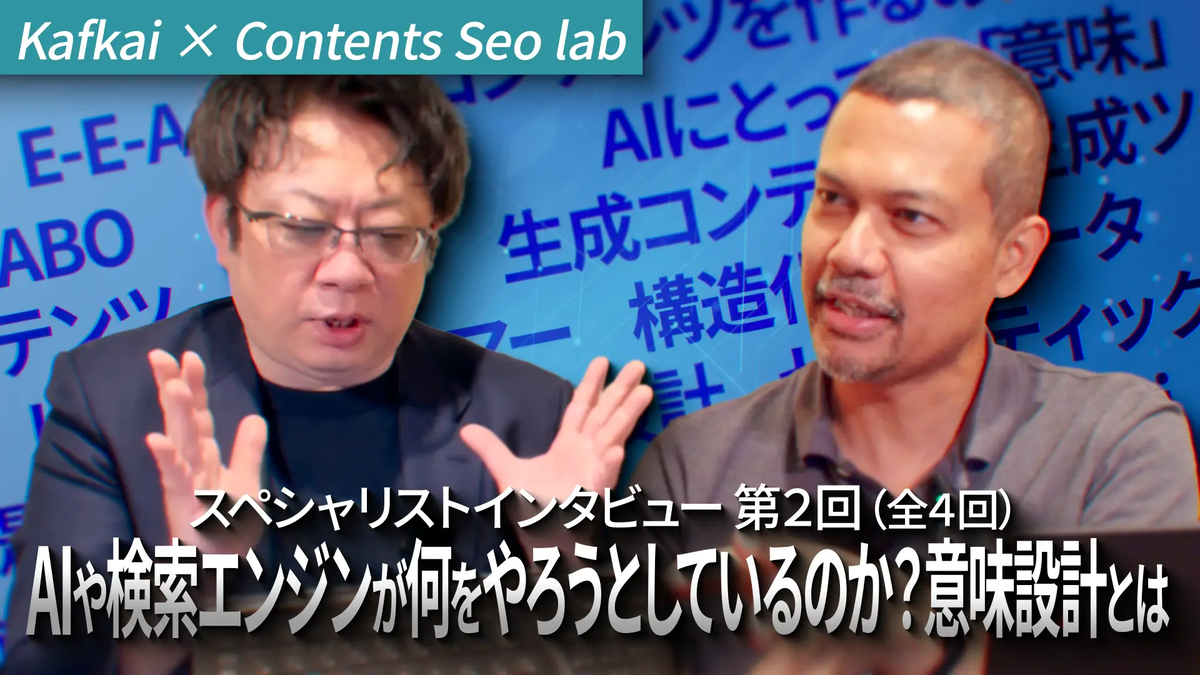
This article is the second in a dialogue series between Takeshi Gunji, who has approximately 20 years of specialized experience in search engine SEO, and Iqbal, who operates Kafkai, an AI analysis and automated content generation service specialized for web agencies, titled "Meaning Design: A New Paradigm for Being Correctly Understood by Search Engines and AI."
In our previous discussion, we explored how AI has begun to "dominantly intervene" in search results and introduced the concept of "meaning design" as a new paradigm for content creation in the AI era. Today, we delve deeper into the practical application of this concept. Why do we create content in the first place? And what kind of "meaning design" is necessary for AI and search engines to correctly evaluate it? Let's unpack these questions through concrete examples.
Crayon Shin-chan Teaches Us the Problem of "Perspective Relativity"
"Crayon Shin-chan, right? There's a child's perspective, a parent's perspective, a TV station's perspective, and a sponsor's perspective—and the value changes completely depending on which viewpoint you take."
Gunji's observation here symbolizes a fundamental problem in modern content marketing. For the same query "Crayon Shin-chan," different perspectives seek entirely different values:
- Child's perspective: "Is it funny or boring?"
- Parent's perspective: "Is it good or bad for education?"
- TV station's perspective: "Are the ratings good or bad?"
- Sponsor's perspective: "Is the advertising effective or not?"
Thus, the "value" transforms completely depending on how you set the "key" (perspective). Yet in our daily lives, we often ignore this premise when discussing things. When we say "Crayon Shin-chan was funny, wasn't it?"—is that from a child's perspective? A parent's perspective? Or a critic's perspective?
"When we create content, we tend to ignore these perspective differences and just say things like 'Crayon Shin-chan was funny, right?'"
This "unconscious premise" is precisely why AI and search engines fail to understand correctly. Humans can communicate expecting the other party to share the same context, but AI cannot. Because AI cannot infer context, we must explicitly design these premises into our content.
The Trap of Ambiguous Words Like "Commitment"
"When you say 'water with commitment,' I think different people imagine completely different things."
Iqbal's point here strikes at the biggest pitfall in marketing. Words like "commitment," "quality," and "sophistication"—these abstract terms create 10 different interpretations among 10 different people. Yet we continue to use these words as if they convey clear meaning.
Gunji's example of "Egashira" illustrates how meaning changes over time without the person changing:
"Ten years ago, Egashira-san, today's Egashira-san, and Egashira-san ten years from now—their existence completely changes in our perception, right? The person himself hasn't changed at all—he's just living according to his own style and personalized character—but how we see him changes."
This "change in perception without change in the person" perfectly demonstrates how "meaning" is context-dependent. Ten years ago, Egashira was seen as "the epitome of creepy comedians," but now he's considered "an approachable figure." The person hasn't changed; only the social context has, yet the value has completely transformed.
Case Study: Onigiri with Ultra-Soft Water—From Ambiguity to Specificity
The most detailed example discussed was onigiri made with ultra-soft water—a perfect case study in the practice of meaning design.
Level 1: Vague Expression (Not Good)
"We use committed water. We use committed ingredients. We make committed onigiri."
What's wrong with this expression? As Gunji points out:
"Just saying 'We use committed water, committed ingredients, committed onigiri' doesn't communicate anything to AI, and to consumers, 'committed' is vague, right?"
Because the word "committed" itself is ambiguous, no one can imagine the same thing. AI and search engines cannot evaluate it correctly.
Level 2: Specific Level (Okay)
"We use ultra-soft water. Ultra-soft water has extremely low mineral content."
This is a step forward. But it's still insufficient because it doesn't clearly explain why low minerals are valuable—the value transformation based on perspective is missing.
Level 3: Completed Meaning Design (Optimal)
"We use ultra-soft water. Because ultra-soft water has extremely low mineral content, it penetrates deeply into the rice, making it fluffy when cooked. Due to the low mineral content, the rice's natural aroma and sweetness are enhanced."
This expression contains a perfect Query-Key-Value chain:
- Query: "How to make fluffy onigiri?"
- Key: "Ultra-soft water"
- Value: "Low minerals → deep penetration → fluffy cooking → enhanced aroma and sweetness"
This logic chain allows all 10 people to imagine the same mechanism. AI and search engines can understand it accurately and match this content to appropriate queries.
Two Keys to Moving Consumer Psychology: Self-Efficacy and Sunk Cost
Iqbal introduced psychological concepts to show that meaning design isn't just information organization—it's a mechanism that drives actual purchase behavior.
Self-Efficacy: Giving Consumers Confidence in Their Choices
"Self-efficacy means, in a sense, one's own decision-making. When faced with the choice of what to buy or whether to buy, it's the confidence level of being able to choose with assurance."
Applying this concept to marketing creates the following flow:
- Educational content: Provide information like "the difference between soft and hard water" or "how mineral content affects rice cooking"
- Knowledge acquisition: Consumers learn selection criteria and increase their self-efficacy
- Brand engagement: They feel "thanks to this brand, I can make smart choices"
- Purchase behavior: They choose with confidence
"Now I've learned about water, understand the difference between soft and hard water, and know how it pairs with onigiri. As I gain more knowledge, I gain confidence—my self-efficacy increases."
This mechanism functions as value-added provision that goes beyond mere product description. Being able to choose based on criteria other than price is a very positive thing for consumers.
Sunk Cost Effect: Not Wanting to Waste Learned Knowledge
An even deeper psychological effect is the sunk cost bias:
"There's something called sunk cost bias—the feeling that you don't want to let go of the effort and accumulation you've invested."
The knowledge consumers learn through content is an investment for them. For example:
- Time spent learning about ultra-soft water mechanisms
- Cognitive energy expended to understand mineral content differences
- Effort spent comparing multiple options
The psychology of not wanting to "waste" these investments leads to the action: "I've learned this much, so I might as well try the committed onigiri."
"Once you've learned this much, you definitely want to try the committed onigiri at least once."
This is the exact same mechanism as being unable to cut losses on stocks—humans have a motivation to not easily let go of learned costs.
Beyond Price Competition: Creating New Reference Points
"Consumers who have only price as their sole option—this is what we call commoditization—become generalized."
Gunji's warning here points to the typical trap that many brands fall into. Consumers who can only choose based on price become "commodities" that can easily flow to competitors.
Diversifying Reference Points
The true value of meaning design lies in creating reference points beyond price:
- For water: Hardness (soft/hard), mineral content, source location
- For pork: Breed (three-way crossbred, Agu, Tokyo X), breeding environment (natural/caged), origin (domestic/imported)
- For onigiri: Rice variety, cooking method, water quality, nori quality, filling origin
"General consumers being able to choose only by price is very unfortunate, but if you take pork, for example, recently when you go to tonkatsu or curry shops, you see tonkatsu curry made with three-way crossbred pork, right? That's marketing based on crossbreeding three types of pigs."
Thus, providing information that broadens choice is the core of meaning design. Consumers learn "what criteria to use for selection" instead of just "cheap or expensive."
A New Approach to Competitive Analysis
"When considering competitive analysis, from the brand's perspective, we need to think about what perspective humans use to make choices in that decision-making process, and within that context, products and services are ultimately selected."
Traditional competitive analysis studied "what competitors are doing." But meaning design requires understanding what criteria users actually use to choose.
This shift is crucial because:
- Understanding user perspective: Grasp the actual reference points consumers use
- Clarifying differentiation: Identify on what axis you can differentiate beyond price
- Designing content strategy: Build meaning design along that axis
"Therefore, when thinking about competitive analysis, it's important to first clarify what perspective we use to choose things. The simplest and most understandable perspective is price."
Price is the simplest reference point but also the most competitive battlefield. The goal of meaning design is to create richer, more defensible reference points.
Practical Steps for Meaning Design
So how can we practice meaning design? From Gunji and Iqbal's dialogue, we can derive the following practical steps:
Step 1: Visualize Your Premises
Before creating content, clearly list its premises:
- Target audience: Who are you writing for? (e.g., food manufacturer marketers)
- Context: What challenges do they face? (e.g., want to escape price competition)
- Perspective: From whose viewpoint are you speaking? (e.g., producer, consumer, expert)
- Purpose: What do you want to achieve through this content? (e.g., create new reference points like water quality)
Step 2: Clarify Query, Key, and Value
Organize your core message in Query-Key-Value format:
- Query: The challenge users face (e.g., "How can I differentiate?")
- Key: Your product or service (e.g., "Onigiri made with ultra-soft water")
- Value: The unique value you provide (e.g., "Low minerals → deep penetration → fluffy cooking → enhanced aroma and sweetness")
Step 3: Eliminate Ambiguous Words and Make Them Measurable
Replace vague words like "commitment," "quality," and "delicious" with measurable indicators:
- ❌ "Committed water"
-
✅ "Ultra-soft water with mineral content below 30mg/L"
-
❌ "Delicious onigiri"
- ✅ "Onigiri where moisture penetrates to the center of each grain, creating a fluffy texture"
Step 4: Include Context to Prevent "Cut-Out" Problems
To avoid the SNS "cut-out problem," always explicitly include important context:
- ❌ "Our product is the best"
- ✅ "For users facing [specific challenge], our product provides the best value in terms of [specific benefit]"
Step 5: Verify and Improve with AI
Finally, have generative AI analyze your content to verify how it's being understood:
Prompt example:
"Reading this article, what Value do you perceive?
What premises are missing?
For what Queries does this content provide Value?"
Use this feedback to make your meaning design clearer.
The Fateful Collaboration Born from a 20-Year Relationship
"Like the story of Zhuge Liang, so to speak, Iqbal-san is truly opening new frontiers for us. He will serve as lead researcher for our Content SEO Lab, and we plan to move forward with Iqbal at the center, guiding our AI-related technology."
Gunji's statement suggests something beyond a mere business partnership. A relationship spanning nearly 20 years, and now in 2024, meeting again with AI as a new theme—"people who have advanced on different layers" reuniting. This is precisely the fateful moment where traditional SEO knowledge and cutting-edge AI technology—expertise cultivated in different dimensions—intersect.
Iqbal, an AI expert active as a Python Foundation fellow, was shocked by Gunji's "meaning design" concept, saying "I think the first time this appeared was from Gunji-san." This speaks to the innovativeness of this new paradigm. It's the proof of Gunji's insight in identifying a fundamental issue in the relationship between content and AI that even AI technologists hadn't noticed, discovered through 20 years of SEO practice.
Looking Ahead—Implementation of Meaning Design
In this article, we focused on "perspective relativity" and "the problem of ambiguous words" to explain the practical approach to meaning design. However, understanding theory alone is insufficient. How do you actually implement it in content, measure its effectiveness, and improve it?
In our next Part 3, we will use case studies from actual projects undertaken by Gunji and Iqbal to delve deeper into the practical implementation of meaning design and techniques for verifying its effectiveness. Particularly, we'll share practical insights on how to produce large-scale content using generative AI without falling into average expressions, and how to create AI-optimized content by combining structured data with meaning design.
In an era where AI "dominantly intervenes" in search engines, whether your business or brand gets buried is no longer determined by "the number of keywords" but by "the quality of meaning." Please look forward to the next installment of this dialogue where 20 years of SEO achievements fuse with cutting-edge AI technology.
Guest Profiles
Takeshi Gunji
A web customer acquisition consultant with approximately 20 years of specialized experience in search engine SEO. He has consistently been at the forefront of SEO evolution, from keyword-based traditional SEO to semantic search, and now to "meaning design" in the AI era.
Iqbal Abdullah
The CEO of LaLoka Labs, which operates Kafkai, an AI-powered business intelligence service for web agencies. An AI technologist who is also active as a Python Foundation fellow. He promotes the practical implementation and ethical use of generative AI, and through his collaboration with Mr. Gunji, handles the technical implementation of AI-era content strategy.
This series is linked to the YouTube video (in Japanese) "CONTENTS SEO LAB Specialist Interview #2: "The Current State and Challenges of SEO" (4-Part Series)" The video includes detailed explanations in addition to the content introduced in this article. Please watch it as well.
Related Articles

ChatGPT Has 3.2% of Search. That Number Is Both Reassuring and Dangerous (Part 3)
SparkToro's data shows AI tools hold just 3.2% of desktop search. That looks small, and it is. But if you focus only on the current number and ignore the structural mechanics underneath, you will be caught off guard by the shift that is already happening.
Not All Searches Are Equal, and Pretending They Are Will Cost You (Part 2)
SparkToro's research lumps Amazon product searches, YouTube video queries, Instagram lookups, and Google searches into one basket. That is a category error, and if you base your marketing strategy on it without understanding why, you will misallocate your budget.
SparkToro Says Google Has 73% of Search And I Have Questions (Part 1)
SparkToro's latest research claims Google has only 73.7% of desktop search when you count 41 major websites. The number is interesting, but the methodology behind it deserves serious scrutiny before anyone rewrites their marketing strategy.