Published in AI & SEO
Meaning-Driven Design: Redefining SEO in the AI Era – The Moment When 20 Years of Experience Meets Cutting-Edge AI Technology

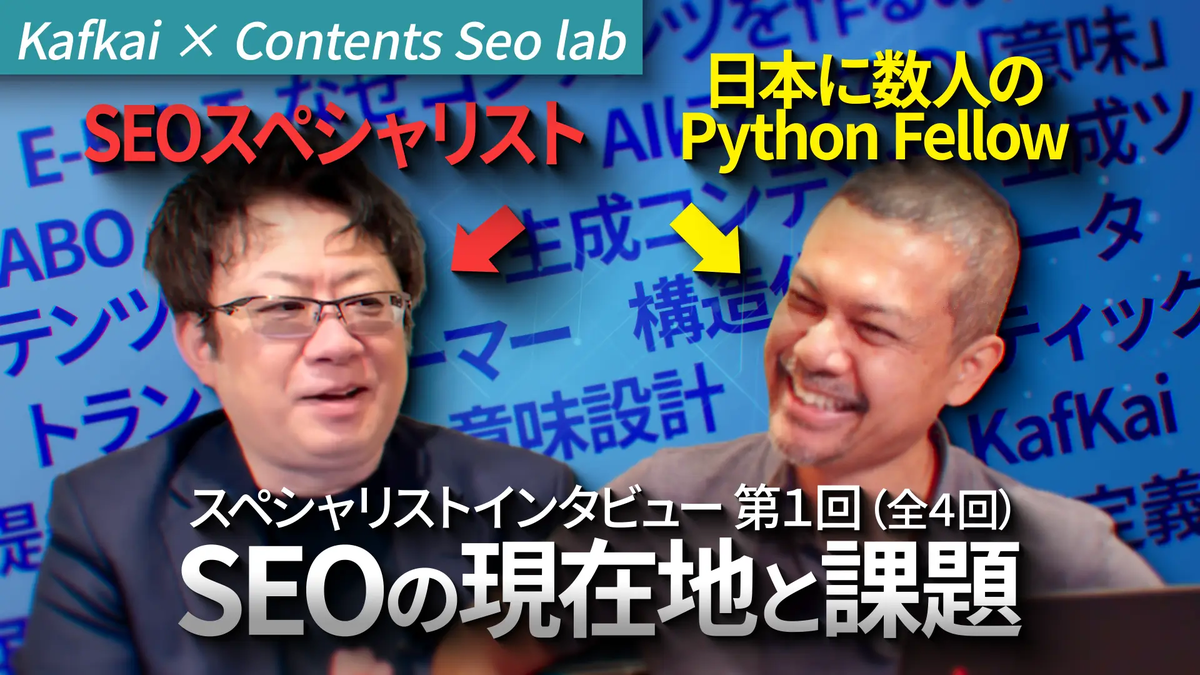
Keyword Stuffing No Longer Works—The Evolution of Search Engines and the Rise of AI
"In the early 2000s, the methods to display websites at the top of search results were surprisingly simple. Just by writing the keyword 'rental office' repeatedly on a page, you could get close to the top of search results."
As Mr. Gunji recalls, the search engines back then had a 'very simple algorithm,' where the frequency of keyword appearance was the primary indicator for ranking.
However, this technique called 'keyword stuffing' rapidly lost its effectiveness with the evolution of search engines. Starting with Google, search engines shifted significantly towards understanding user intent and providing truly valuable content rather than just matching text strings. At the core of this change lay the concept of 'semantic search.'
"As for the term SEO, most people are unaware of it, right? So, to solve the problem of delivering our service to everyone in order to address how they can deliver their services, if people don't know the word SEO, they won't be able to access our pages. This is a very unfortunate situation."
Mr. Gunji's point symbolized the limitations of traditional search. Even when users search with concerns like 'not being able to attract customers' or 'website visitors not increasing,' without knowing the technical term SEO, they can't find appropriate services. To bridge this gap, search engines started trying to understand the 'meaning' of keywords themselves."
AI Overview: Search Moves to AI
Then in 2024, another major change came to the search engine world. Google's "AI Overview" feature became mainstream, with AI-generated direct answers appearing at the top of search results.
As Mr. Gunji says, "The big change in search engines was AI Overview," this wasn't just a feature addition—it was a turning point showing that the search platform itself is shifting to AI.
"AI is becoming dominantly involved in search engines. This has become a very big challenge for me."
This change presented new challenges that couldn't be addressed with traditional SEO alone. In an era where AI "answers" search results, simply getting a web page "displayed" is no longer enough. It has become crucial to influence AI to correctly and favorably explain your service or brand.
What is Meaning Design?—A New Way of Thinking for Being Correctly Understood by AI

The most important keyword in this dialogue is "meaning design." As I pointed out, I first heard of this concept from Mr. Gunji and is a new paradigm of content creation that Mr. Gunji advocates.
Without Clear Premises, Meaning Won't Be Conveyed
Mr. Gunji's everyday example, "It's hot today, isn't it?" is a perfect illustration of the core of meaning design. In human conversation, this phrase is generally understood even without context. That's because we share implicit premises: the location (Tokyo office), the date (October 3rd), the season (autumn), and past temperature experiences.
But what happens when AI analyzes this conversation?
"If, for example, I said 'It's hot today, isn't it?' while in Antarctica, or in the middle of the Sahara Desert, the meaning would be completely different."
These "premises" are the most crucial element of meaning design. AI cannot understand implicit context like humans can. Therefore, we need to explicitly design these premises into our content.
How AI Understands Meaning: The Transformer Architecture
To understand why meaning design is important, we need to know how modern AI understands language. Mr. Gunji explains the "Transformer" technology at its core.
"The AI Transformer uses three relationships—Key, Query, and Value—to understand meaning and context."
Specifically:
- Query: The word or question being focused on (e.g., "cold")
- Key: The perspective or target (e.g., "water" or "person")
- Value: The meaning or value created by their combination
In the case of "cold water," when the Query "cold" points to the Key "water," the Value is "temperature." However, with "cold person," the same Query "cold" with the Key "person" transforms the Value into "unfeeling" or "lacking kindness."
This mechanism allows AI to infer meaning from the relationships between words, not just keyword matching. However, it also carries the risk that if the relationship between Query and Key is unclear in the content, AI will assign the wrong Value.
The SNS "Cut-Out Problem" and Meaning Transformation
This risk manifests in ways that significantly impact our daily lives. Mr. Gunji's example of the "SNS problem during the House of Councillors election" is a prime case.
"There was a background where, during a debate program, a current LDP minister mentioned that 'SNS accounts are being deleted one after another,' but only the part about 'deleting accounts' was cut out and spread as a narrative about 'censorship.'"
In this case, the act of "deleting accounts" has completely different meanings depending on context:
- Key: "Human accounts" → Value: "Censorship," "infringement of free speech"
- Key: "Bot accounts" → Value: "Security measures," "prevention of public opinion manipulation"
However, on SNS, this crucial premise (Key) was omitted, and only the fragmentary information "deleting accounts" was spread. This is precisely meaning transformation through context cutting, one of the major problems of modern digital society.
AI-Era Content Strategy—Beyond Average Expressions
"AI collects vast amounts of data, but if you ask it to write about your company, it can only do so using average words and average expressions, right?"
This was my observation that basically captures AI's essential nature. Generative AI, based on probability patterns in training data, inevitably tends to produce average, generic, and ordinary expressions.
Differentiation Through Meaning Design
This AI characteristic poses a major challenge for business. To distinguish your brand or service from thousands or tens of thousands of competitors, you need expressions that are clearly characterized, not average. This is where meaning design plays a crucial role.
Mr. Gunji states: "The important thing is to have no average writing or expression, to be clearly differentiated, to write clearly, and to have precise expressions that align with meaning design."
Exactly. So, Meaning-Driven-Design means:
- Clarifying premises (who, where, when, why)
- Accurately defining Query-Key relationships (what, to whom, how they relate)
- Clearly presenting unique Value (what value is provided)
By explicitly designing these three elements, you can make AI correctly understand your unique meaning and recognize a Value different from others.
The Difference from Structured Data As We Know It
Some might wonder, "How is this different from structured data (like schema.org)?"
Structured data is standardized markup to help machines understand the "type" of content. For example, it explicitly states "this is a recipe" or "this is a review."
Meaning design, however, is a more fundamental level of design. It's the work of designing the context, intent, and value relationships themselves. If structured data defines "what it is," meaning design defines "what it means and for whom it is valuable."
Practical Steps for Meaning Design—What You Can Start Today
So how can you actually practice meaning design? From our dialogue, we can derive the following practical steps:
Step 1: Visualize Your Premises
Before creating content, clearly list its premises:
- Target audience: Who are you writing for? (e.g., startup founders, solo entrepreneurs)
- Context: What situation or problem do they face? (e.g., can't attract customers, no SEO knowledge)
- Place & time: When and where is this information needed? (e.g., Japan, 2024, economic downturn)
- Purpose: What do you want to achieve through this content? (e.g., get them to understand your service, prompt inquiries)
Step 2: Clarify Query, Key, and Value
Organize your core message in Query-Key-Value format:
- Query: The problem or desire users have (e.g., "can't attract customers")
- Key: Your service or product (e.g., "SEO consulting")
- Value: The unique value you provide (e.g., "customer attraction support based on meaning design that differs from average strategies, backed by 20 years of experience and AI-era knowledge")
Step 3: Expression That Prevents Context Cutting
To avoid the SNS "cut-out problem," always explicitly include important context:
- ❌ "We deleted the account" (Key is unclear)
- ✅ "We deleted the bot account" (Key is clear)
- ✅ "We deleted fake accounts designed to manipulate public opinion for security reasons" (Premise, Key, and Purpose are clear)
Step 4: Verification and Improvement with AI
Finally, have generative AI analyze your content to verify how it's being understood:
- "Reading this article, what Value do you perceive?"
- "What Premises are missing?"
- "For what Queries does this content provide Value?"
Use this feedback to make your meaning design clearer.
A Fateful Collaboration Born from 20 Years of Relationship
The background to this dialogue lies in our long-standing relationship and a shared sense of crisis and vision regarding SEO in the AI era.
I have been consulting with Mr. Gunji on business matters since 2007, and our initial one-hour discussion turned into a highly valuable two-hour conversation due to our heated debate.
On December 11, 2024, we officially decided to establish a partnership between CONTENTS SEO LAB (5th floor, 1-9-4 Asakusa, Taito-ku, Tokyo), where Mr. Gunji serves as the representative director, and LaLoka Labs, which I represent, for the operation of Kafkai. We aim to build a new paradigm in AI-era SEO.
Mr. Gunji began his activities as a special researcher at the Japan SEO Association from 2010, contributing to the enlightenment and development of SEO through the publication of papers and seminars at the Tokyo International Forum, among other events. Since 2011, he has been providing consulting services for general companies and SEO professionals, and since March 2017, he has also served as a technical committee member of the SEO Certification Examination Committee, supervising examinations and reference books, earning high recognition within the industry.
His research findings are characterized by in-depth analyses based on Google's algorithms and patent information, setting him apart from general SEO information or speculation-based content. The patents (Patent No. 2018-116626, Patent No. 2018-101283) held by Mr. Gunji attest to his technical depth.
In 2023, Mr. Gunji established CONTENTS SEO LAB, offering services based on deeper insights and evidence."
"Like the story of Zhuge Liang, so to speak, or as a reference example, Iqbal-san is truly opening new frontiers for us. He will serve as lead researcher for our Content SEO Lab, and we plan to move forward with Iqbal-san at the center, guiding our AI-related technology."
Mr. Gunji's statement suggests something beyond a mere business partnership. A "nearly 10-year" relationship since 2007, and now in 2024, meeting again with AI as a new theme—"people who have advanced on different layers" reuniting. This is precisely the fateful moment where traditional SEO knowledge and cutting-edge AI technology—expertise cultivated in different dimensions—intersect.
Myself as an AI expert active within the Python community and as a Python Foundation fellow, was shocked when I first heard of Mr. Gunji's "meaning design" concept. At that time, I said "I think the first time this appeared was from Mr. Gunji." This speaks to the innovativeness of this new paradigm. It's the proof of Mr. Gunji's insight in identifying a fundamental issue in the relationship between content and AI that even AI technologists haven't noticed, discovered through 20 years of SEO practice.
Looking Ahead—Toward Practical Meaning Design
This article explained the importance of "meaning design" and its theoretical background in AI-era search engines. However, understanding theory alone is insufficient. How do you actually implement it in content, measure its effectiveness, and improve it?
In the next Part 2, we will use case studies from actual projects undertaken by Mr. Gunji and myself to delve deeper into the practical methods of meaning design and techniques for verifying its effectiveness. Particularly, we'll share practical insights on how to produce large-scale content using generative AI without falling into average expressions, and how to create AI-optimized content by combining structured data with meaning design.
In an era where AI "dominantly intervenes" in search engines, "the quality of meaning," not "the quantity of keywords," determines everything for whether your business or brand gets buried. Please look forward to the next installment of this new paradigm where 20 years of SEO achievements fuse with cutting-edge AI technology.
Continue to Part 2 of this series titled "Meaning Design Part 2: Value Changed by Perspective, and Practice for Correctly Communicating to AI".
Guest Profiles
Takeshi Gunji
A web customer acquisition consultant with approximately 20 years of specialized experience in search engine SEO. He has consistently been at the forefront of SEO evolution, from keyword-based traditional SEO to semantic search, and now to "meaning design" in the AI era.
Iqbal Abdullah
The CEO of LaLoka Labs, which operates Kafkai, an AI-powered business intelligence service for web agencies. An AI technologist who is also active as a Python Foundation fellow. He promotes the practical implementation and ethical use of generative AI, and through his collaboration with Mr. Gunji, handles the technical implementation of AI-era content strategy.
This series is linked to the YouTube video (in Japanese) "CONTENTS SEO LAB Specialist Interview #1: "The Current State and Challenges of SEO" (4-Part Series)" The video includes detailed explanations in addition to the content introduced in this article. Please watch it as well.
Related Articles

ChatGPT Has 3.2% of Search. That Number Is Both Reassuring and Dangerous (Part 3)
SparkToro's data shows AI tools hold just 3.2% of desktop search. That looks small, and it is. But if you focus only on the current number and ignore the structural mechanics underneath, you will be caught off guard by the shift that is already happening.

Not All Searches Are Equal, and Pretending They Are Will Cost You (Part 2)
SparkToro's research lumps Amazon product searches, YouTube video queries, Instagram lookups, and Google searches into one basket. That is a category error, and if you base your marketing strategy on it without understanding why, you will misallocate your budget.

SparkToro Says Google Has 73% of Search And I Have Questions (Part 1)
SparkToro's latest research claims Google has only 73.7% of desktop search when you count 41 major websites. The number is interesting, but the methodology behind it deserves serious scrutiny before anyone rewrites their marketing strategy.