Published in Business Community
What Malaysia's Startup Year-End Party Reveals About Our Tech Ecosystem

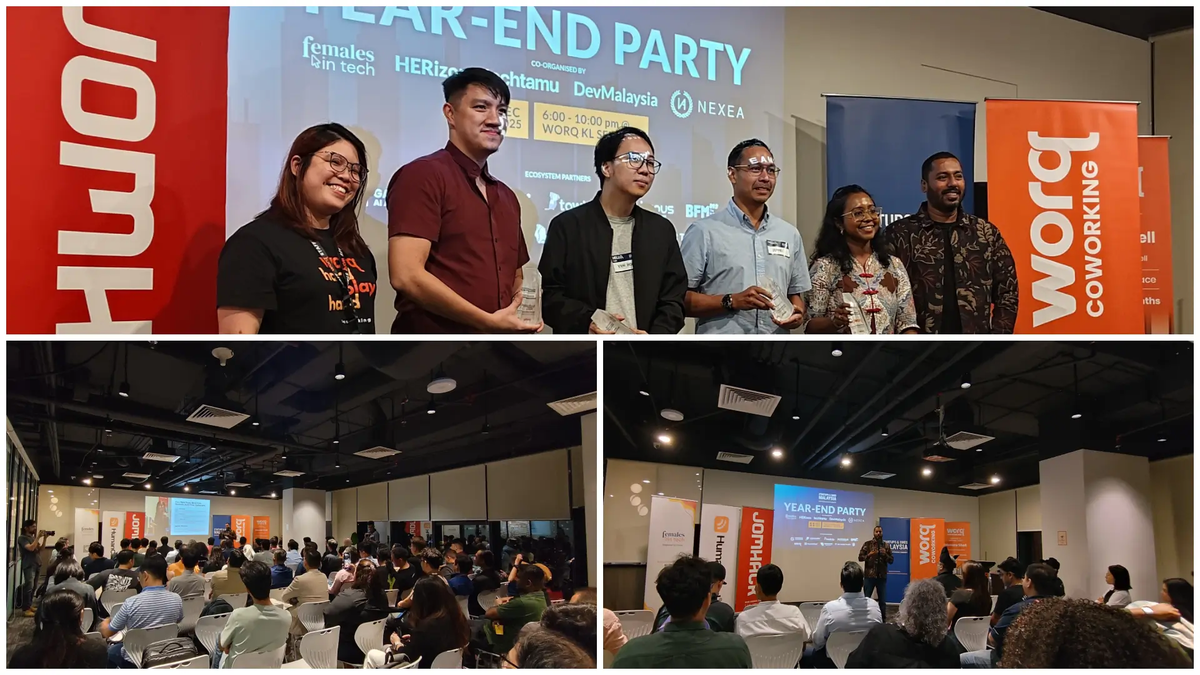
On December 11, 2025, I found myself on the 20th floor of Menara 1 Sentrum, looking out over Kuala Lumpur's skyline as over 100 founders, developers, and tech professionals filled the WORQ coworking space. This wasn't just another meetup with forced networking and elevator pitches. The Startups & SMEs Malaysia Year-End Party brought together tech communities plus NEXEA for a moment of collaboration that said more about our ecosystem's maturity.
Here's the bottom line: Malaysia's startup scene has evolved from mamak stall gatherings to structured communities that are now intentionally cross-pollinating. The event revealed both our progress and persistent challenges, from free AI bootcamps achieving 90% placement rates to the stubborn gender imbalance that three women-focused initiatives still struggle to solve.
Disclaimer: I'm basing what I'm writing on this post from my scribbled notes and memory so I will most probably get something or someone wrong. Please get in touch with me here or here if you think something needs to be fixed.
The Gathering: More Than Just a Party
Most tech events follow a predictable formula: presentations, Q&A sessions, then awkward networking over coffee, nasi lemak or karipap. This year-end party was not that. I came in and everyone was already having biryani dinner and engaging in conversation. From 6 PM to 10 PM, the format was simple: Biryani, drinks, saying hello from the community leads and then pure mingling.
The sponsor list was impressive: Gamuda AI Academy, EngineMailer, TawkTo, Printcious, WORQ, HumanCard, Tech Jobs Malaysia, Beamstart, and E3.
I couldn't help but notice what this signals about our ecosystem's evolution. I don't live here so am basically an outsider and have minimal historical knowledge, but seeing companies funding community building events throughout the year without immediate ROI is a great thing.
Just to add: We're also signed up and using services by two of the sponsors: EngineMailer and TawkTo.
The venue choice itself told a story. WORQ KL Sentral isn't a hotel ballroom. It's a coworking space where startups actually work. The 20th-floor view gave us all a literal perspective on the ecosystem we're building. As the sun set over KL, the room filled with conversations in different languages with different people, a microcosm of Malaysia's multicultural heritage and advantage.
The Communities: Many Voices, One Ecosystem
After having dinner and mingling around for a bit, we all gathered into the biggest room and the talks started. So I'll list them in the order they came up front to greet the room.
JomHack: Turning Programmers into AI Developers
Inbaraj Suppiah, founder of JomHack, opened the evening with the kind of results that make you lean forward. His Gamuda AI Academy runs a three-month bootcamp that transforms programmers into full-stack AI developers. Three intakes annually, 200 graduates so far, and a 90% placement rate within one to two months.
"The program is completely free," Inbaraj said.
What I found fascinating: a 90% placement rate for a free program suggests either massive corporate CSR investment or a government skills initiative. It's also interesting that the candidate profile are people within the ages 21-40 and they must know Python or JavaScript. So this isn't just for fresh grads; it's also for career changers and retrenchment cases. Malaysia's tech disruption is creating a reskilling wave that traditional educational institutions aren't catching.
Inbaraj also runs a 30-day Python bootcamp for non-technical founders—doctors, accountants, PhDs who can't find technical co-founders or afford developers. In 30 days, they're building functional applications.
What this tells me: The "learn to code" movement has evolved from hobbyist weekend workshops to serious career transition programs. When specialists are willing to spend 30 days learning Python instead of hiring developers, it signals either a talent shortage or a cost crisis for early-stage founders.
Other than code, Inbaraj also partners with a content creator (I missed to take down the name) with millions of followers across TikTok and YouTube, to run a paid content creator bootcamp. For founders who need to promote their businesses, this is practical wisdom. Distribution skills are as critical as product development.
Act2: Dash The Veteran
Dash Dhakshinamoorthy isn't new to this. He's been building communities since the early 2000s, when Malaysia's startup scene meant gathering at mamak stalls with plastic chairs, listening to pioneers like Mark Cheng of Jobstreet.
"I brought Global Entrepreneurship Week and Startup Weekend to Malaysia after meeting the founder in Silicon Valley," Dash recalled. "We didn't have WhatsApp groups or coworking spaces. We had word of mouth and determination."
Today, Dash runs Act2, helping people in midlife transition to entrepreneurship, and Cambridge Entrepreneurs Malaysia, which—despite the name—is open to non-Cambridge alumni.
What Dash represents is something I don't see discussed enough: Malaysia's demographic shift. The focus on "midlife entrepreneurship" isn't just a nice-to-have. It's a response to corporate layoffs, ageism in tech hiring, and the reality that people in their 40s and 50s have the experience and networks to build sustainable businesses. This isn't the "move fast and break things" generation—it's the "build something that lasts" generation.
Dash's core message hit hard: "Most entrepreneurs don't start with blockbuster ideas or VC funding. They start with who they are, what they know, who they know, and what they can afford."
I think that there's a growing recognition that the Silicon Valley model doesn't transplant cleanly to Malaysia. Dash's "effectuation" philosophy—starting with means rather than goals—feels more honest to our context.
Females in Tech: 5,000 Members, 800 Active
Elaine, co-founder of Females in Tech, didn't sugarcoat the reality. "Look around the room," she said. "The gender imbalance is visible."
As a data scientist, Elaine has lived the male-oriented nature of tech. Her organization, which evolved from "Girls in Tech" around three to four years ago, now has over 5,000 members. But only 800 to 1,500 are active participants.
That 16-30% active participation rate is a common stickiness issue with grass roots community movement. I've seen this pattern across communities: Large membership numbers but low engagement. The question is why? Are events not relevant? Is timing bad? Or are women facing time and resource constraints that we don't discuss enough?
Females in Tech runs free events focused on technical upskilling, leadership, and entrepreneurship. They've organized 36 events, but Elaine humorously acknowledged their free model depends on sponsors continuing to show up.
HERizon: Mapping the Women's Ecosystem
Jesyka Hiu from HERizon described her organization as a "movement and platform for women in leadership and business across Southeast Asia." But what caught my attention were her three core functions—and what they reveal about systemic gaps.
First, HERizon cultivates a support system across Asia, emphasizing that women-focused organizations aren't competitors but niche players working together.
Second, they conduct "high-impact, low-cost events focused on the boring stuff"—reading P&L statements, understanding CEO vs CMO vs COO roles, actual leadership skills.
I think this is what's missing. We celebrate fundraising announcements and product launches, but nobody teaches founders how to manage cash flow or structure a cap table. HERizon is filling a crucial education gap.
Third, they highlight underrepresented women's stories that mainstream media ignores.
This is where I saw the most heads nodding. Malaysian media loves unicorn stories and overseas success narratives. But the woman building a sustainable business in Ipoh or Kota Kinabalu? We don't hear that often enough. HERizon's new initiative to map women's economic ecosystem for government and corporate access might directly addresses this data gap. The fact that communities must create their own maps suggests official statistics are missing huge segments of the economy.
TechTamu: Revitalizing Cyberjaya's Tech Scene
Sham Hardy founded TechTamu with a specific mission: revitalize tech activities in Cyberjaya, an area that was historically important but "somewhat forgotten."
TechTamu runs monthly Saturday gatherings for 50-100 people, charging nominal ticket fees that cover unlimited coffee and nasi lemak. In 2025, they've held 10 events and expanded to Penang with MDEC support.
I've been fortunate enough to be able to attend one and speak at another of their events.
The Cyberjaya angle fascinated me. Malaysia's tech geography has shifted dramatically. In the 2000s, places like Cyberjaya and PJ were tech hubs. Now everything seems concentrated in KL city center and Bangsar South. Sham's effort to "revitalize" Cyberjaya is fighting against infrastructure drift—where talent, investors, and venues have migrated to newer, shinier locations.
Sham acknowledged the location challenge that Cyberjaya might be "too far" for some attendees but he's pushing forward. In 2026, TechTamu plans training programs and expansion to KL and northern Malaysia.
DevMalaysia: Consolidating Developer Communities
Tevan Raj, founder of DevMalaysia, explained his community as an umbrella organization incorporating JavaScript Malaysia, ColorPool, QGIS, and Ruby on Rails. Earlier in 2025, they hosted a Cloudflare-sponsored event that attracted 300 developers.
I think Malaysia has dozens of tiny, fragmented language-specific groups. DevMalaysia's umbrella approach suggests these communities realized fragmentation was limiting their impact. There's strength in numbers, especially when negotiating sponsor deals or venue partnerships. I wonder why the Python community is not included here.
DevMalaysia focuses on free workshops and CTO fireside chats, bringing developers together to learn from practitioners. They successfully held events in Kota Kinabalu in 2025 and plan expanded activities across Malaysia in 2026.
NEXEA: The 100% COVID Survival Rate
The last presentation that I managed to capture was from NEXEA, an incubator/accelarator/VC operating in Malaysia.
A NEXEA representative shared three program areas, but one statistic was amazing: zero portfolio companies failed during COVID-19. Some even launched second businesses during the pandemic.
Let me put this in perspective. I asked Gemini and looked it up. Global startup failure rates during COVID were estimated at 30-40% (refer to here and here). NEXEA's 100% survival rate is statistically remarkable. Perhaps the mentorship model that hey have providing guidance from professionals with IPOs, exits, and regional expansions was effective.
NEXEA highlighted three portfolio companies that achieved 100x growth or more, with Lapasar growing 528x since investment. Their Entrepreneurs Programme (EP) brings together 100 members managing $5 billion in collective revenues for monthly peer learning sessions.
The $5B collective revenue number is huge. These has to come not only from just early-stage startups; they're scale-ups and mature companies. NEXEA's model seems to focus on post-product-market-fit companies that need mentorship for regional expansion, not just seed funding. That's a gap that not many VCs address I think.
They also have what they call the "Entrepreneur's Camp": Two-day retreats in scenic locations with campfire sharing sessions creating a space for founders to discuss losing co-founders or navigating near-death runway situations.
The Philosophy: Building Without Transaction
Inbaraj concluded his talk by presenting practical networking advice:
- Prepare strategically: Identify key people before events and research attendees
- Connect authentically: Network naturally rather than forcing connections
- Follow up thoughtfully: Send personalized messages referencing specific discussions
- Nurture long-term: Build relationships through periodic check-ins
But the deeper philosophy came from Dash's earlier comment: "Leave your ego at the door. Community organizers must be givers, not takers."
This no-transaction mindset is the antidote to the networking fatigue everyone feels. How many events have we attended where someone immediately pitches their startup? This attitude is common in the open-source community which I am also involved with, but less so when it comes to business like communities like startups, especially on this side of the planet.
Familiar Faces
I did meet new people during the event, but there are also familiar faces such as Tevan Raj, Hanniz Lam who we partnered with for their Sweet November Rave Event and the folks from Enginemailer (Jeffri and Muhajir, who are also one of the sponsors for this event) which I also met during my trip up north to Penang for Founders and Funders 2025.
I also caught up with Sham and Mazin Siraj who hosted me during their Techtamu events.
Interesting Conversations
An interesting conversation I had was with a founder currently working to mend what we broadly describe as a “broken” dating scene. They (I will not use a gendered pronoun here to respect the privacy of my source) explained the issues they view as the primary barrier to finding a compatible partner.
That exchange unfolded into a passionate critique of how indecisive some people can be.
When we shared our ages, they remarked that I belong to “the last of the brave generation.”
The conversation proved fascinating.
What This Means for Malaysia's Tech Future
After getting back to my hotel room from the event, I think I can write down two observations based on my understanding of our startup scene:
1. From Content to Connection
The deliberate absence of panels and presentations signals a maturation in what we value. Early-stage ecosystems need content: How to pitch, how to build, how to raise. Mature ecosystems need connections: Trusted relationships, peer support, mentor-mentee bonds. Makes sense for something Inabaraj is spearheading, since they have been around for a while.
2. From Centralization to Decentralization
Techtamu's Cyberjaya revival, DevMalaysia's Kota Kinabalu events, and HERizon's Southeast Asia ambitions all point to one thing: We have more space outside of KL. Our friend from Penang Curry Khoo might not agree, though.
Conclusion: A Glimpse Of Our Ecosystem
The Startups & SMEs Malaysia Year-End Party wasn't just a celebration. It was a snapshot of where we've come from and where we're heading. The gathering of communities, each with its own mission and story, underscored the progress Malaysia's tech ecosystem has made over the years. From JomHack's AI bootcamps to NEXEA's impressive COVID survival rate, it’s clear that our startups are innovating, scaling, and building resilience in a rapidly changing world.
A refreshing turn was that there wasn't much talk of AI and its impact. The people that I talked to who were running businesses also didn't mention AI (other than one developer who was ranting about how his managers wants to have "AI agents"). I'm not sure if this was intentional on their part, or there wasn't much interest in AI.
But this event also highlighted the challenges we still face such as gender imbalance, regional disparities, and the need for more inclusive growth. The fact that Females in Tech has over 5,000 members but only a fraction actively participating speaks to broader systemic issues that require attention. Similarly, TechTamu's efforts to revitalize Cyberjaya remind us that Malaysia's tech ecosystem isn't just about KL, it’s also about creating opportunities across the country.
As I have always been saying in my community work, we never have enough opportunities.
Related Articles
Techtamu #7: The Power of Global Business - Lessons from Malaysia's Tech Community
Techtamu returns with stories of resilience, global thinking, and the technical fundamentals that keep businesses alive.
Tokyo Chamber of Commerce Taito Branch Young Entrepreneurs Sept Meeting Report
An evening of new members speech and networking
MAJECA JAMECA Joint Conference: Spotlight on Malaysia-Japan Startups (that uses AI)
The MAJECA JAMECA Joint Conference, held in 2024, highlighted innovative Malaysian and Japanese startups in fintech, AI, and space technology, emphasizing collaboration's role in driving technological innovation and growth.