Published in Business Community
Founders & Funders 2025: Penang's Tech Community Addresses AI, Funding, and Ecosystem Challenges

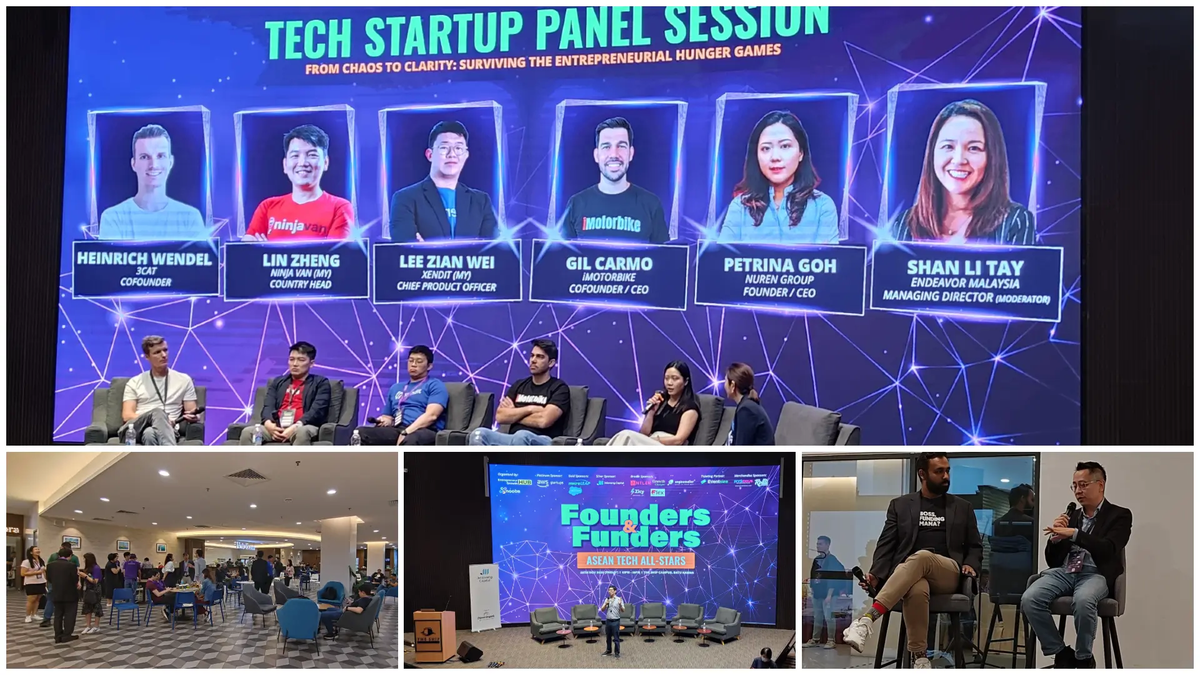
Batu Kawan, Penang - On the 28th of November morning at The Ship Campus, a venue that uniquely combines a logistics company's training facility with a college, Malaysia's peninsula northern startup community gathered for candid discussions about the state of the ecosystem. The Founders & Funders ASEAN Tech All-Stars (FFATAS) event focused on practical challenges: why enterprise AI adoption remains in proof-of-concept phases, the financial realities of entrepreneurship, and the ongoing divide between Penang and Kuala Lumpur's tech scenes.
I got to know about this event from long time agitator and startup community organizer Curry Khoo. We first met at the SDEC 2025 Event in October and hit it off immediately. Curry is based in Penang (for now) so I took the opportunity to drive up, enjoy Penang hospitality and join in the conversation.

The Ship Campus: A Logistics Company's Solution to Talent Development
Shaun Yeoh, VP of The Ship Campus, opened by explaining why Peak 80 Group, a logistics company handling automotive parts, F&B, FMCG, and E&E for clients like Mazda, Zoos Coffee, Daiso, and Tesla, established its own college. "My big boss, Datuk Seri Dr. Michael Tio, wanted to solve his own talent problem. Train his own qualified logisticians," he said. The company decided to build the educational infrastructure rather than wait for the existing system to adapt.
The campus functions as a mixed-use facility: a 500-seat Opera Theatre, smaller meeting halls, co-working and co-living spaces, F&B outlets, a gym, and Peninsula College offering diploma through postgraduate programs. Shaun described the value proposition:
our real USP, honestly, is our network... You want to make key decision-makers from startups, SMEs, MNCs, GLCs, government: Everything in between. Please come to us.
He noted the eight Tesla chargers outside were already being used by participants, while (jokingly?) offering attendees a RM3,000 Tesla discount. The underlying model is straightforward: address talent shortages by creating targeted educational programs.
Agentic AI: Three Years of Proof-of-Concept Cycles
AWS's Ghaz Iqbal started with his keynote and presented data showing that enterprise AI adoption has remained in experimental mode for three consecutive years. He outlined how organizational questions have evolved:
2023 questions focused on basics: "What is generative AI? Is this secure? Do I need to become a prompt engineer?"
2024 questions shifted to optimization: "How do I prioritize projects? How can I lower costs?"
2025 questions now address transformation: "How can we leverage agents? How can we transform our entire business?"
Despite this progression, many organizations remain in Proof Of Concept (POC) mode. Ghaz noted the irony:
- Three-quarters of organizations meet or exceed ROI targets, with customer service seeing 14% faster resolution rates and 9% reduced handling time.
- Gartner predicts agentic AI adoption will increase from 1% to 33% of enterprise apps by 2028, but this requires moving beyond experimental phases.
He demonstrated practical application with Amazon QuickSight: "Three or four months ago, I used to spend two, three, four hours on monthly business reviews. Now I write a prompt, and in two to three minutes I get the report. It actually feels like cheating your way through all of that."
Defining Truly Agentic AI
Agentic AI represents autonomous systems that reason, plan, and complete tasks. Ghaz explained the evolution from machine learning solving singular problems, to LLMs answering questions, to agents performing work through feedback loops similar to human processes.
He emphasized a key distinction: "Not every AI system is agentic. Don't call basic AI-powered customer support 'agentic' unless an LLM is actually taking steps to solve problems autonomously." The measure is meaningful reduction in human oversight, not just automation of existing workflows.
There's a difference between agentic AI and agentic workflow. I've touched on what does agentic AI mean in my post here during my coffee chat with Khalil Nooh
Founder Finance: The Practical Questions About Personal Sacrifice
We had a session where invited founders were called on stage to talk about their experience. I came in just during the Q&A time, and I'm listing down here some of the interesting questions that we had.
An attendee who is also interested in starting something on her own asked what many entrepreneurs wonder:
"How much do you spend? Will I be hungry to death? Can I still put food on the table for my kids?"
The responses reflected varied experiences:
Gil Carmo (iMotorbike), who bootstrapped and exited successfully, shared: "I had to borrow a lot of money. I had three and a half years with no salary." His advice: "Try to do it as a part-time until you're sufficient, comfortable enough to jump. Don't do it otherwise because you'll be shocked."
Lee Zian Wei (Sendit) described his approach: "We couldn't pay ourselves a living wage. I was paying ourselves minimum wage while paying our employees a lot more, and that was a very long time. We took our own savings to pump into the company."
Heinrich Wendel (BEAM) who was working in corporate multinationals before venturing on his own offered a different perspective: "It's about mentality over exact numbers. What helped was the confidence that if this doesn't work out, I can go back to corporate anytime. I've been there, done it."
The panel agreed there's no universal rule. Bootstrapping is possible but requires understanding the financial and personal trade-offs, including the real possibility of business failure.
As an entrepreneur who bootstrapped—even before the term was widely used—I can empathize with the panelist.
What I would add is that the importance of a support network often gets lost when this subject arises. Entrepreneurs are, by definition, a positive, optimistic, and confident group, and we often overestimate our own capabilities. However, we also tend to forget that when we take a risk, there are family, friends, and others around us who provided emotional support, encouragement, and even practical assistance that enabled us to persevere.
Semiconductor Development: Malaysia's Talent and Infrastructure Gaps
Just before dinner, the final talk was a fireside chat moderated by BFM's Roshan Kanesan with SkyChip's co-founder, Teh Chee Hak.
Teh provided technical insights into Malaysia's semiconductor industry challenges. Teh, previously with Intel and Altera, identified three major hurdles:
- Foundry access: Requires established relationships and strategic selection of manufacturing partners
- Back-end design skills: Ability to translate designs into transistors that comply with foundry rules
- Front-end architecture: The most significant gap—developing ideas for next-generation improvements (like LPDDR2→LPDDR5 memory evolution)
Transition from Corporate to Startup
Teh explained his motivation for leaving MNCs: "I've been in a lot of meetings in MNCs where you spend meetings after meetings justifying why you need to have for the next meeting. To me, it's a waste of time because you could put your time to much better use to build something you want to be proud of."
His wife's encouragement was influential: "She said, if you don't try this now, you may regret it. What's the worst that can happen? If you fail, you figure out what to do next."
VC Funding as Credibility Marker
SkyeChip raised venture capital despite profitability. Teh explained: "Early on, a potential customer asked, 'Who's your VC?' We said none. They replied, 'So how do I know you guys are legit? Has anybody done due diligence on you before?'"
Without VC backing, companies risk being perceived as "a shell company, for all anybody knows." Having Gobi Partners as an investor signaled that "somebody did due diligence," which "helps whenever we engage bigger companies."
The funding also provided global network access, crucial for markets in the US, China, Taiwan, and Singapore—"very small market in Malaysia." The company's recently exposed draft prospectus suggests an imminent main market IPO.
Training New Talent
Regarding talent development, Teh noted Taiwan's requirement for masters degrees in IC design. SkyeChip takes a practical approach: a rigorous six-week training program for fresh graduates, followed by a buddy system pairing juniors with seniors.
"A lot of our local graduates lack practical work," he observed. "Knowledge-wise, they have a lot, but without doing practical work, you can't connect the dots."
Ecosystem Fragmentation: The KL-Penang Divide
Throughout the event, participants noted Malaysia's geographically fragmented tech ecosystem. Curry Khoo and Shaun observed that "majority of them are not from Malaysia, and even not from Penang" when organizing events. Social media helps, but has limitations—"they don't search for this kind of thing."
Curry was direct about the challenge: "Most of my speakers are from KL. The vibe, everything is from KL. So here when you do things, it's very lonely. All my buddies, all my network, all my friends are from KL."
He's considering relocating to KL despite family in Penang: "I want to do more things. But because family kids are here, so..."
Hallway Chats
Conferences and meetups like this are just not only the talks. Meeting random people and getting conversation started in the hallway is the real value.
AI Explainability: The Challenge of Hallucinations and Blockchain Limitations
In one of my hallways discussions, I talked with Nathan Phillips, a Penang native recently returned from London. Nathan brought up a core question: If AI produces incorrect answers in demos, what happens when managing critical systems like supply chains?
The key insight: Hallucination isn't a bug but an inherent characteristic. As one participant explained, "The guardrails that govern this when you train a model is to be helpful. The concept of not knowing itself is alien to the model. What is 'I do not know'? These are just probabilities to it."
AI operates non-deterministically, selecting from probability distributions rather than making definitive choices. While Retrieval Augmented Generation (RAG) can narrow options, human judgment remains essential for final decisions.
OH: "Never believe anyone who tells you they're using AI and can give you 100% correct answers. It is not possible."
Regulatory and Technical Constraints
This creates particular challenges in regulated industries like finance, where decision explanations are mandatory. Neural networks function as black boxes—when data flows through billions of parameters, tracking each transformation becomes impossible. There are research to try and understand how Large Language Models (LLMs) think, but we still do not know the precise reasoning path.
Nathan suggested blockchain could track AI data usage for audit trails. The response highlighted computational limitations: "GPT-5 has over a trillion parameters. How do you physically track that? You'd need to call the blockchain a trillion times for one problem. No blockchain can handle that scale."
The consensus of our discussion: accept AI's probabilistic nature and design human oversight into critical decisions rather than seeking perfect traceability.
Enterprise AI Adoption
One other interesting conversation I had was with a freelance developer which we will name as "Kawan".
Kawan shared his experience pithching to a certain Malaysian public company dealing in consumer hardware. He proposed using ChatGPT for customer service but encountered immediate concerns: "They don't really trust that kind of thing. They're afraid their data will be leaked."
The specific worry involved pricing data. If customer queries about hammer prices went through OpenAI, "what if my competitor also uses OpenAI?"
That doesn't make sense, but Kawan then suggested an on-premise solution, but the timeline and costs expectations created a gap. This was what Kawan said:
Kawan's assessment: Custom model development needs 3 to 4 months to build plus a year to train.
Client's requirement: "Cannot. I need it in three months and will only pay RM50K"
Hardware costs alone—"GPU satu dah seratus ribu boh" (one GPU is already a hundred thousand)—illustrate the gap between enterprise AI expectations and implementation realities.
Community Building Realities
I also took the opportunity to talk to Curry Khoo about the startup community here in Penang.
The ecosystem relies heavily on volunteer effort. Curry noted: "It's a passion thing. People won't appreciate, people will complain." He encouraged attendees to write about the event: "That will help me research it out. We will showcase. We need people to talk about it."
Well Curry, I hear you and so here we are.
The Venue

The Ship is a unique building located just across Penang island connected to it via the Penang Second Link Bridge. If you're lucky enough to not get stuck in traffic, getting here from Bayan Lepas airport will take you around 40 minutes. Public transportation is non-existent, so you need to drive or get taxi or a Grab car. If you're unfortunate enough to have to go through the peak hour traffic, you might need at least 1.5 hours.
The bridge itself is a magnificent piece of engineering, spanning across 2.4 kilometers and is currently the longest bridge in Malaysia and second longest in South East Asia (the longest is Brunei's Sultan Haji Omar 'Ali Saifuddien Bridge).
Key Takeaways for Founders
-
AI is powerful but probabilistic: Hallucination is an inherent characteristic, not a flaw. Design human-in-the-loop processes for critical decisions and be skeptical of 100% accuracy claims.
-
VC funding provides credibility beyond capital: For B2B companies, VC backing serves as third-party validation that can be essential for enterprise customer trust.
-
Bootstrapping requires significant sacrifice: 3.5 years without salary is not uncommon. Paying employees more than founders is typical. Maintain a realistic exit plan.
-
Malaysian ecosystem needs scale thinking: Regional collaboration is essential but requires overcoming geographic and network fragmentation.
-
Practical experience remains irreplaceable: Whether in semiconductors or other technical fields, hands-on work is necessary to complement academic knowledge.
-
International markets offer opportunities: Targeting markets like Japan, US, and Europe can be more viable than focusing solely on Malaysia.
-
Community building needs sustainable models: Volunteer-driven initiatives require long-term planning to maintain momentum.
Conclusion: A Community Assessing Its Challenges
Founders & Funders 2025 functioned as a candid assessment of Malaysia's tech ecosystem. Discussions covered AI adoption barriers, financial pressures on entrepreneurs, credibility challenges for bootstrapped companies, geographic fragmentation, and talent development gaps.
Despite these challenges, our enterpreneurs demonstrated resilience. Teh launched SkyeChip based on his wife's pragmatic encouragement. Gil endured 3.5 years without salary to achieve a successful exit. Shaun's organization solved its talent pipeline by building educational infrastructure.
I've never doubted it, but FFATAS has once again shown to us that Malaysia's tech scene possesses talent, ideas, and determination. The focus now is on scaling operations, building trust across regions, and having honest conversations about what regional and global competition requires. I also find The Ship Campus model—combining education with industry—may offer one path forward to solve talent shortage issues.
As Curry Khoo later noted, "Malaysia are getting better. There's a lot of investors from all over the world coming over." The question remains whether Penang can leverage these opportunities while retaining talent that might otherwise move to KL.
Related Articles
Techtamu #7: The Power of Global Business - Lessons from Malaysia's Tech Community
Techtamu returns with stories of resilience, global thinking, and the technical fundamentals that keep businesses alive.
Tokyo Chamber of Commerce Taito Branch Young Entrepreneurs Sept Meeting Report
An evening of new members speech and networking
MAJECA JAMECA Joint Conference: Spotlight on Malaysia-Japan Startups (that uses AI)
The MAJECA JAMECA Joint Conference, held in 2024, highlighted innovative Malaysian and Japanese startups in fintech, AI, and space technology, emphasizing collaboration's role in driving technological innovation and growth.