Published in AI & SEO
Meaning Design, Part 4: The Paradigm Shift from Google's "Most Relevant" Algorithm to Content and Authors.

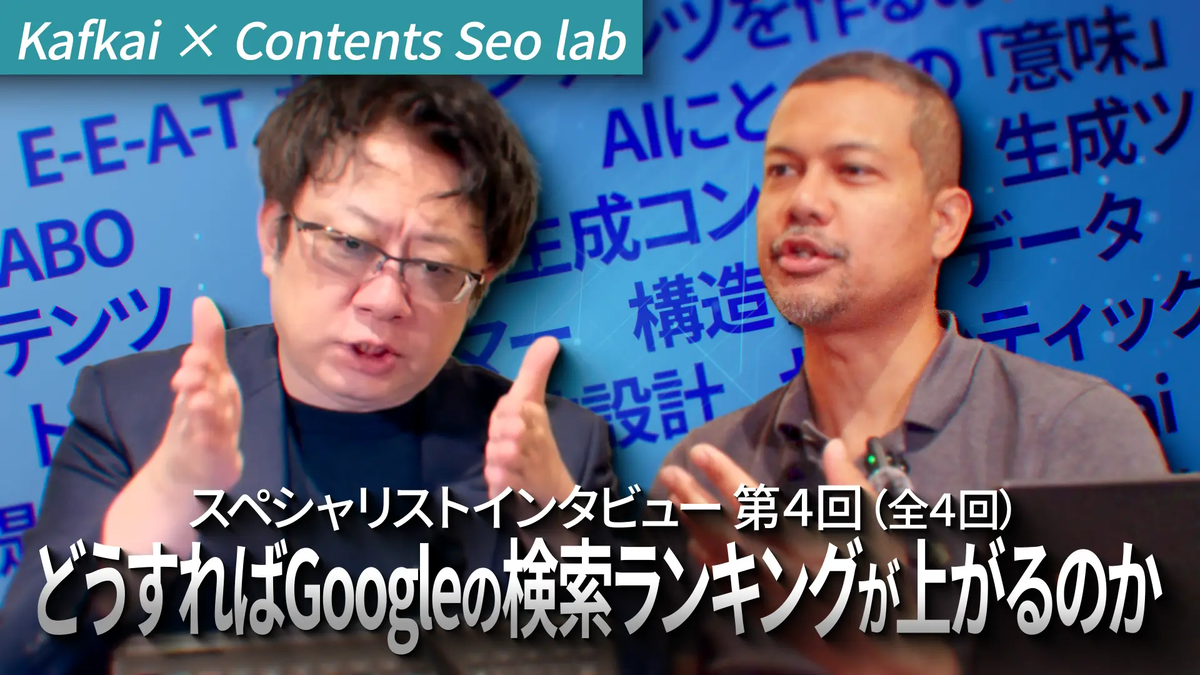
In the previous installments, we explored how the definition of competitors has changed, the importance of converting sales knowledge into content, and how to achieve differentiation by creating reference points beyond price. However, a more fundamental question remains: How exactly does Google judge "quality"? How does AI decide whether to recommend our services or not?
This time, we dive into this most essential question.
Everything Is Determined by Formulas—AI Doesn't Subjectively Judge "Good or Bad"
"Everything is ranked by formulas. So just because AI exists doesn't mean that the AI somehow judges good or bad subjectively."
This statement from Gunji-san corrects the biggest misconception many people have. With the advent of generative AI, it's easy to assume that search results are determined by "AI's subjective judgment." But that's not the case.
No matter how much AI technology evolves, at the foundation of search rankings lie clear evaluation criteria and formulas. AI isn't magically judging things as "seems good somehow"—it's evaluating based on established standards.
So what are these evaluation criteria?
E-E-A-T: Google's Four Documented Evaluation Axes
"What Google search engine clearly shows as evaluation axes is E-A-T. It's a somewhat unfamiliar term, but first, there's trustworthiness, authoritativeness, expertise, and experience—these four evaluation axes are used for ranking, and this is documented every year in a 180-page guideline."
Google publishes an annual 180-page guideline that clearly outlines the evaluation criteria. That's E-E-A-T:
- Experience: Is the information based on real experience?
- Expertise: Is it written by someone with specialized knowledge?
- Authoritativeness: Is the author an authority in the field?
- Trustworthiness: Is it from a trustworthy information source?
However, a major problem emerges here.
How Do You Judge Abstract "Something-ness"?
"What becomes problematic here, and what I want everyone to be conscious of, is that expertise and trustworthiness—these concepts with the character '性' (meaning '-ness')—are very vague, right? They're abstract and vague concepts. So the question is, how do you judge these?"
"Expertise," "Trustworthiness," "Authoritativeness"—these are all abstract concepts.
- What constitutes having "trustworthiness"?
- What constitutes having "expertise"?
- What constitutes having "authoritativeness"?
When I, Iqbal, hear "high quality," the first thing that comes to mind is "written by someone with knowledge." However, for others, the definition of "high quality" might be completely different. It could be design beauty, comprehensiveness of information, or readability.
"For some people, they might look at quality from a different perspective. Such variability is inevitably a structural problem inherent in anything with '-ness.'"
How does Google resolve this ambiguity?
The "Likelihood" Approach: Understanding Through the Pro Wrestler Example
"This is clearly stated in Google's patent documents. So when it comes to how to evaluate such '-ness' qualities, Google takes what's called a 'likelihood' approach."
Likelihood—this is Google's solution. However, this also sounds like a "vague" concept. Let's understand it through Gunji-san's brilliant example.
The "Likelihood" of Being a Pro Wrestler
"For example, if I were to claim in my profile that I'm a pro wrestler, no one would believe me, right? Because I don't look like a pro wrestler."
Imagine this: Gunji-san claims, "I am a pro wrestler." Would you believe him? Probably not. Because his appearance and physique aren't "pro wrestler-like."
But what if someone weighing 120 kilograms with a muscular build said the same thing? You might think, "Maybe it's true."
"But for some people, if I say I'm a pro wrestler, they might accept that I'm a pro wrestler. So whether I'm a pro wrestler or not isn't just about whether I claim to be one, but also whether I appear that way to others. They're judging based on likelihood, right?"
In other words, rather than proving the fact "I am a pro wrestler," they're evaluating "signals that make me look like a pro wrestler."
Multiple Signals Constitute "Likelihood"
"So specifically, Iqbal, do you watch pro wrestling?"
I watched pro wrestling as a child, but I don't watch it now. However, I do have an image of what a pro wrestler is.
"Most people think you need a built physique, but there were small pro wrestlers too. Probably one or two among the group. Also, the techniques are different, and each wrestler has techniques only they can perform. It varies completely by person, right?"
Even among pro wrestlers, physique and techniques vary. However, there are common signals:
- Abundant muscle mass: More muscle than the average man
- Agility: Fast speed, nimble movements
- Solid build: An overall trained body
"But somehow the image of a pro wrestler consists of, as mentioned earlier, having a solid build. For example, having abundant muscle mass—more muscle mass and content than the average male. Also, there's agility, speed, and such. There are several signals."
What's important is that judgment is based not on a single signal but a combination of multiple signals.
- Abundant muscle → Could be a bodybuilder
- Abundant muscle + Agility → Seems like a pro wrestler
"But with just that, they might be a bodybuilder. But if agility is added, they can move a bit and become more pro wrestler-like, and differences emerges, right? As several conditions combine."
This is precisely Google's "likelihood" approach.
Implementing "Likelihood" in SEO
"So the thinking that Google adopts is that when evaluating vague things like expertise and trustworthiness, they analyze what signals to look for to determine expertise. This becomes the product of likelihood."
Just as judging the "likelihood" of being a pro wrestler, Google analyzes multiple signals to determine "expertise" and "trustworthiness."
"If these conditions are met, this can be identified as a pro wrestler. Similarly, trustworthiness and expertise take the same approach."
And these signals aren't just guesses—they're explicitly stated in Google's patent documents.
"Likelihood—and then in terms of SEO, what we do is that Google clearly shows in its patents what signals to look for. If these conditions are met, it can be determined to have expertise, and we work based on that."

The True Nature of Quality: Coverage of Perspectives (Comprehensiveness)
So what specifically is "quality"? Gunji-san addresses the most important point.
"This is the main topic, right? How do you improve rankings? What Google explains about quality is perspective coverage. How many perspectives can you present?"
Quality = Coverage of Perspectives
This is the essence of Google's definition of "quality."
Considering Diversity of Perspectives Using "Cars" as an Example
When Gunji-san wanted to talk about "cars," he asked me what perspectives could be considered.
"For example, when I say let's talk about cars with Iqbal, what would you talk about?"
What I came up with:
- Manufacturers: Nissan, Toyota, Benz
- Domestic vs. Foreign
- Electric vs. Gasoline cars
- Environmental impact
"From a manufacturer standpoint, Nissan, or Nissan, Toyota, Benz, and such. Then foreign-made cars versus domestic cars, electric cars versus non-electric cars—what's the difference? And if you develop that further, how do electric cars versus gasoline cars impact the environment? That becomes a completely different perspective, right?"
In response, Gunji-san adds more perspectives:
"As Iqbal mentioned, for example, environmental issues, or cost-performance issues like fuel efficiency—there are various things, right? Some people, when discussing cars, talk about how cool they are, like 'Ferraris are cool'—they discuss design. But others might talk about where you can get good deals, or about the used car market."
Organizing this, the perspectives for discussing "cars" include:
- Manufacturers (Nissan, Toyota, Benz, etc.)
- Domestic vs. Foreign
- Power source (Electric vs. Gasoline vs. Hybrid)
- Environmental issues (CO2 emissions, impact on global warming)
- Cost-performance (fuel efficiency, maintenance costs)
- Design (aesthetic appeal)
- Sales price (new vs. used cars, discounts)
- Dealerships (reputation, service)
"As Iqbal said, from environmental issues to the recent world of electric vehicles, EVs, to hybrids and such, there are various topics. From design to dealerships, it's very diverse."
Quality = How Many Diverse Perspectives You Cover
"At this point, what Google calls quality is coverage. How much perspective coverage—the word comprehensiveness comes up here, but articles that show more diverse perspectives are evaluated, and that becomes the measure of quality."
In other words, what's considered high quality in an article discussing "cars":
- ❌ An article discussing only manufacturers
- ❌ An article biased only toward environmental issues
- ✅ An article showing diverse perspectives including manufacturers, environment, cost, design, sales, etc.
"It means you must not be biased, right? In terms of perspective."
Exactly. Biased perspectives are considered low quality.
Crayon Shin-chan Teaches "Relativity of Perspectives"—Facts Change Depending on the Viewer
Here, Gunji-san brings up the example of Crayon Shin-chan again, which appeared in Part 2.
"Another important thing is to remember Shin-chan from before. If you keep insisting that Crayon Shin-chan is funny content, in one sense that's correct, but in another sense, it's incorrect, right?"
That Crayon Shin-chan is "funny" is a correct evaluation from a child's perspective. Children view programs based on "funny or boring," so they can argue "it was funny."
"That's because children view it in terms of funny or boring, so they can keep talking about how funny it was. But from a parent's perspective, it's not good for education—the way of seeing it is completely different, right?"
However, from a parent's perspective, it's completely different. Parents evaluate programs based on "educationally good or bad," resulting in a judgment of "not good for education."
"So when you take a biased perspective, it's correct from one aspect but incorrect from another. In that sense, even a single fact changes in truth depending on who's looking at it, right? Even though the same thing is happening, it changes completely depending on the person's perspective."
Facts and Values Change with Perspective
This is exactly the relationship of "Query-Key-Value" we learned in Parts 1 and 2.
- Fact: The program Crayon Shin-chan
- Perspective (Key): Child or Parent
- Value: Funny or Not good for education
Even with the same fact, if the perspective (key) changes, the value derived from it is completely different.
"So what Google defines as quality, from that standpoint, is first to find perspectives and arguments that people don't notice. And another thing is it's important to discuss from multiple perspectives."
What Google seeks in "high-quality content":
- Find perspectives and arguments people don't notice
- Discuss from multiple perspectives
"As Iqbal mentioned, the environment too—if you look at it in the context of global warming, cars are like this, right? And from a design standpoint for people who think it's cool, you can say all sorts of things. The facts change completely, and the values change too."
The Paradigm Shift from Content Evaluation to Author/Operator Evaluation
Then Gunji-san discusses the most important turning point in modern SEO.
"Traditionally, search engines, and AI as well, evaluated the content itself. But now, there's the perspective of who is writing it, who is disseminating it, who is the operator, and the era has come where authors or operators are being ranked."
Traditionally: Evaluating the Content Itself
Search engines used to evaluate the quality of the content itself. They analyzed the article's content, keywords, structure, and ranked based on that.
Currently: Evaluating Authors and Operators
But now it's different. Search engines and AI have started evaluating who is writing the content, who is disseminating it, and who is operating it.
"At this point, the evaluation mechanism is where everything we've been talking about converges—first, diversity of perspectives, and writing accurately. We also talked about premises. Writing correctly means clarifying the premise."
In other words, the evaluation criteria are:
- Diversity of perspectives: Are multiple perspectives shown?
- Accurate description: Are premises clarified and is it written correctly?
"While writing correctly and showing many perspectives, site operators who disseminate such information become trusted by AI and receive high scores."
Authors and Operators with Trust Have the Advantage
What does this shift mean?
"So even if the same product is released, as in the real world, a product sold by a trusted entity is easier to recommend, right?"
Exactly. Even with the exact same product:
- Untrusted author/site → Difficult to recommend
- Trusted author/site → Easy to recommend
"So if you want your services to be featured, first of all, show many perspectives and disseminate correct information. I want everyone to keep this in mind."
This isn't just about "writing good articles"—it's a long-term strategy of building trust as an author/operator.
Structured Data: Technical Implementation for AI Understanding
Finally, Gunji-san touched on the technical aspect of structured data.
"And one more thing I haven't touched on today—there's a technology called structured data. The content we create is for humans to view, but structured data is a set of writing rules that make content readable by search engines and AI."
Content for Humans vs. Content for Machines
The content we usually create is for humans to read. However, there's also content for search engines and AI to read. That's structured data.
"If you learn that and can express content as structured data too, AI can understand our content more accurately, and our ranking becomes easier, so these efforts will accelerate going forward. That's the current state, I suppose."
By learning structured data:
- AI can understand content more accurately
- Easier to get ranked
This is also part of the technical implementation of "semantic design" we touched on in Part 1. Not only clarifying premises and accurately defining Query-Key-Value, but also expressing it in a machine-readable format—this is the direction that will accelerate going forward.
Practical Steps: Building "Likelihood" You Can Start Today
So what specifically should we do? Here are the practical steps derived from this dialogue:
Step 1: Identify "Signals" in Your Field
Like "muscle mass" and "agility" for pro wrestlers, identify the signals that indicate "having expertise" in your specialized field.
For example:
- SEO Consultant: Citations of Google patents, specific numerical case studies, accurate use of technical terms
- Chef: Knowledge of cooking science, ingredient origin information, references to seasonality
- Investment Advisor: Market data analysis, understanding of economic indicators, risk management explanations
Step 2: Ensure Diversity of Perspectives
When writing an article, include at least 3-5 different perspectives.
For an article on "cars":
- ✅ Manufacturer comparison
- ✅ Environmental impact
- ✅ Cost-performance
- ✅ Design
- ✅ Used car market trends
Step 3: Make Perspectives Explicit
As we learned in Part 2, make clear from whose perspective you're speaking.
- ❌ "Electric cars are good" (perspective unclear)
- ✅ "From an environmental protection perspective, electric cars can reduce CO2 emissions. However, for consumers who prioritize initial cost, the high price is a drawback" (perspective clear)
Step 4: Build Trust as an "Author" Through Continuous Information Dissemination
Not just one article, but by continuously publishing articles that show diverse perspectives, increase your trust score as an author/operator.
"While writing correctly and showing many perspectives, site operators who disseminate such information become trusted by AI and receive high scores."
Step 5: Learn Structured Data
On the technical side, learn structured data (Schema.org, etc.) to express content in AI-understandable formats.
Conclusion: Becoming a Trusted Entity by AI Is the Starting Point of Everything
"That's the current theme. In this way, not just with search engines but also becoming trusted by AI, the direction I want everyone to recognize going forward is this."
Modern SEO isn't just about "ranking high in search":
- Ranking high in search engines
- Having your services recommended by generative AI
- Being cited in the form of "according to ◯◯"
What's common to all of these is becoming a trusted entity by AI.
"Even a somewhat suspicious person might start to seem like someone impressive, so becoming such an entity is the current theme."
And what's necessary to build that trust:
- Diversity of perspectives: Not biased toward one perspective, but discussing from multiple angles
- Accurate description: Clarifying premises and writing correctly
- Continuous dissemination: Not temporary, but continuously providing valuable information
- Technical implementation: Expressing in AI-understandable formats like structured data
"There will be more different topics and various stories to discuss, so that's it for today. Whether listening or watching, I hope everyone can apply the knowledge gained today to create good content with differentiation, and use it successfully in their business or even in their private life."
Please apply the knowledge learned from our dialogue to your business or private life as well.
Looking Ahead: Practical Edition—Observing the Writing Process
"If there's an opportunity, by actually looking at the writing process together, the before and after, the way of writing in the AI era will become clearer, so it might be good to do something like that."
In this article, we've explained the theoretical framework of Google's "likelihood" algorithm, perspective coverage, and the paradigm shift from content to author evaluation.
As a future development, we're considering making public the actual writing process that Gunji-san and I work on, showing you AI-era writing methods in a "before and after" format.
"There, looking at the past month or half year, there are various tools available too. For example, if you look at search rankings, you'll understand, so it's better to look there."
As actual effect measurement, by analyzing data from the past month or six months and tracking changes in search rankings, we can visualize the practical effects of semantic design.
In an era where AI "intervenes dominantly" in search engines, for your business or brand not to be buried, it's no longer "number of keywords" but "credibility as an author" and "diversity of perspectives" that determine everything.
Please put this new paradigm, which fuses 20 years of SEO expertise with cutting-edge AI technology, into practice.
Guest Profiles
Takeshi Gunji
A web customer acquisition consultant with approximately 20 years of specialized experience in search engine SEO. He has consistently been at the forefront of SEO evolution, from keyword-based traditional SEO to semantic search, and now to "meaning design" in the AI era.
Iqbal Abdullah
The CEO of LaLoka Labs, which operates Kafkai, an AI-powered business intelligence service for web agencies. An AI technologist who is also active as a Python Foundation fellow. He promotes the practical implementation and ethical use of generative AI, and through his collaboration with Mr. Gunji, handles the technical implementation of AI-era content strategy.
This series is linked to the YouTube video (in Japanese) "CONTENTS SEO LAB Specialist Interview #4: "The Current State and Challenges of SEO" (4-Part Series)" The video includes detailed explanations in addition to the content introduced in this article. Please watch it as well.
Related Articles

The Age of AI Recommendations — Can Your Company’s Product Pages Pass AI Screening?
AI must become a partner in the purchasing process, and instead of merely listing specifications, it needs to clarify “who” and “what value” will be gained. Structuring pages so that they are recommended by AI expands the chances of being selected.

SEO Is Not Dead, but GEO Is Not Optional
Two Japanese data-driven articles published days apart arrive at opposite conclusions about SEO. One says it's dead, the other says it isn't. They're both right, and understanding why matters more than picking a side.

Hidden UX SEO Debt: Why Technical SEO Still Costs Businesses Millions
Many businesses focus on content and marketing campaigns, but hidden UX and technical SEO issues often go unnoticed, quietly hurting traffic, conversions, and revenue.